
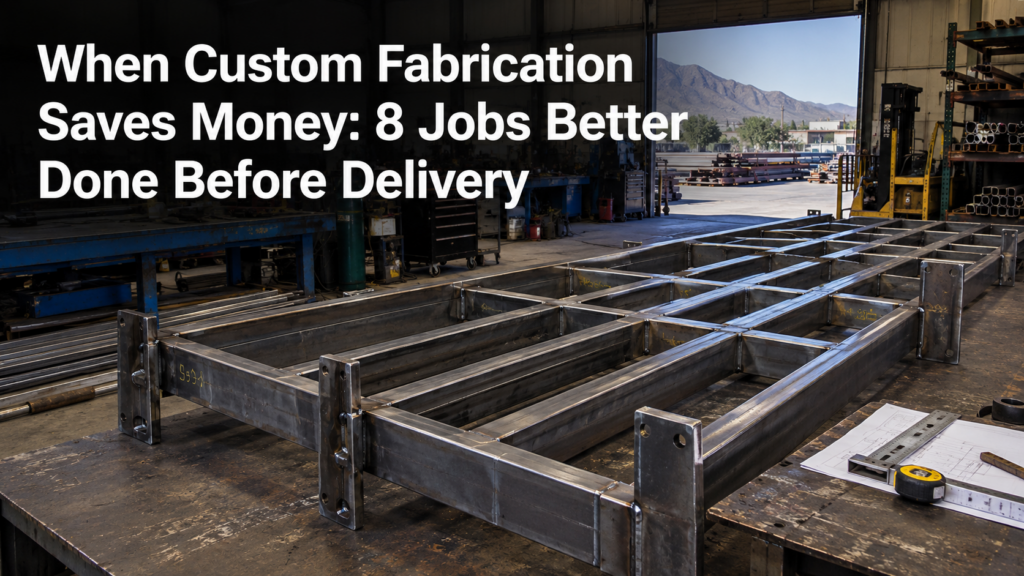
There is a stubborn myth on the job site that buying raw metal and cutting it yourself is the cheaper path. On the quote, it looks that way. The raw stock costs less than the fabricated part. But the quote is not the cost. The cost is what happens after the metal lands. A crew spends hours cutting, drilling, and grinding in the field.
They waste material and burn labor that never shows up on the invoice. That is the hidden math behind why custom fabrication saves money. Work done in a controlled shop, before delivery, is faster, more accurate, and less wasteful than the same work done on site. The trick is knowing which jobs to move upstream. This guide walks through 8 fabrication tasks that are almost always cheaper done before delivery, and the real reasons each one pays off.
The Real Reason Shop Work Beats Field Work
Before the list, it helps to understand why the shop wins. Field work is unpredictable. Weather, congestion, access limits, and multi-trade coordination all slow a crew down and invite mistakes. A shop removes those variables. The numbers back it up. Shifting fabrication from the field to a controlled shop can cut trade labor on site by around 30%. Factory fabrication drops material waste below 3%, while traditional field construction typically wastes 15 to 20% of its material. That gap is the core of why custom fabrication saves money, and it shows up on every job that moves the right work upstream. The savings only hold when the shop does the work well. That is why it pays to know how to spot a true fabrication expert before you hand over the drawings.
Key Takeaway: Shop fabrication cuts field labor by roughly 30% and slashes waste below 3%. That is the core reason custom fabrication saves money on the jobs that move upstream.
1. Precision Cutting to Length
The most basic fabrication job is also one of the most valuable to move upstream. Cutting metal to exact length in a shop is faster and more accurate than fighting a saw in the field. The right saw and a controlled setup make the difference. Repeated cuts are where this pays off most. A patio cover’s rafters, a run of studs, or a batch of identical brackets all cut cleaner and faster in one shop setup. When the pieces arrive at the right length, the crew assembles instead of measures. This is the clearest case where custom fabrication saves money. It removes slow, repetitive field labor.
Key Takeaway: Cutting to exact length in the shop removes slow, repeated field cuts, the simplest way custom fabrication saves money on any build.
2. Bending and Forming
Bending metal to a precise angle takes a press brake and skill, neither of which travels well to a job site. A shop bend is consistent and accurate. A field bend is a guess with a torch and leverage. Any part that needs a repeated, precise bend belongs in the shop. That covers brackets, channel, angle, and formed panels. Consistent bends mean parts fit the first time, which is exactly where custom fabrication saves money on assembly. A structure built from parts that all match goes together faster and cleaner than one where every bend is slightly different.
Key Takeaway: Precise, repeatable bends need shop equipment, so forming before delivery is a job where custom fabrication saves money on fit and assembly.
3. Hole Punching and Drilling
Holes drilled or punched in the shop land exactly where the drawing says. Holes drilled in the field drift, especially across a repeated pattern where a small error compounds into a bolt pattern that will not seat. For any part with a hole pattern, shop drilling is faster and far more accurate. That includes connection plates, base plates, and bolted assemblies. When the holes line up on arrival, the crew bolts the structure together without reaming or re-drilling. Accurate holes are a quiet but real way custom fabrication saves money. A misaligned pattern in the field is expensive to fix.
Key Takeaway: Shop-drilled hole patterns seat the first time, so punching and drilling before delivery is where custom fabrication saves money on bolted connections.
4. Welding Subassemblies
Field welding is slow, weather-dependent, and hard to inspect. Shop welding happens in a controlled setting with better positioning, better quality control, and no wind or rain to fight. The difference in speed and quality is large. Wherever a design allows a subassembly to be welded in the shop and bolted in the field, that is a win. Bolted connections install far faster than field welds, and the shop weld is stronger and cleaner. Moving welding upstream is a major reason custom fabrication saves money on structural work. It improves the finished quality at the same time.
Key Takeaway: Shop welding is faster, cleaner, and easier to inspect than field welding. Welding subassemblies before delivery is where custom fabrication saves money on structural jobs.
5. Coating and Finishing
Galvanizing, powder coating, and painting all work best in a shop, applied to clean, prepared metal in a controlled environment. A field-applied finish rarely matches the durability of a shop finish, and in desert UV that difference shows up fast. Finishing before delivery also protects the metal in transit. It means the crew installs a finished part rather than stopping to coat it on site. For any structure that needs corrosion protection or a specific color, shop finishing is where custom fabrication saves money. It avoids a slow, lower-quality field coating and the callbacks that follow.
Key Takeaway: Shop-applied coatings outlast field finishes and skip a slow on-site step. Finishing before delivery is a clear case where custom fabrication saves money.
6. Complex or Repeated Assemblies
When a project needs the same assembly many times over, the shop’s ability to batch-produce is a huge advantage. Think of a railing section, a frame, or a bracket unit. Set up once, run many, and every piece comes out identical. Batch production in the shop is faster per unit and more consistent than building each assembly by hand in the field. Consistency also speeds installation, since identical parts install the same way every time. For any repeated component, this is where custom fabrication saves money at scale. The savings multiply across every duplicate.
Key Takeaway: Batch-producing repeated assemblies in the shop is faster and more consistent per unit, so it is where custom fabrication saves money at scale.
7. Tight-Tolerance Work
Some parts have to hold a tolerance the field simply cannot match. Precision machining, close-fit connections, and parts that mate with other components all demand shop conditions and shop equipment. Trying to hit a tight tolerance in the field wastes material through trial and error, and still risks a part that does not fit. The shop holds the tolerance the first time. For anything where precision is critical, custom fabrication saves money by getting it right once instead of reworking it repeatedly. It also protects the parts it connects to.
Key Takeaway: Tight tolerances need shop precision, so critical-fit work is where custom fabrication saves money by getting it right the first time.
8. Cut-to-Fit Kits for On-Site Assembly
The highest-value fabrication job is packaging a whole project as a kit: every part cut, drilled, bent, and labeled, ready to assemble on site. This turns a complex build into a set of parts that go together in sequence. A cut-to-fit kit removes nearly all field fabrication, leaving the crew to assemble rather than manufacture. For a homeowner, it turns a daunting project into a manageable one. For a contractor, it compresses the schedule and protects the labor budget. Delivered as a kit, custom fabrication saves money across the entire build, not just one task.
Key Takeaway: Packaging a project as a cut-to-fit kit removes nearly all field fabrication, so it is where custom fabrication saves money across the whole build.
When Field Work Still Makes Sense
Shop fabrication wins most of the time, but not always, and an honest guide says so. Some jobs genuinely belong in the field. Final fit-up adjustments, connections to existing structures with unknown dimensions, and pieces too large to transport all favor field work. Very small one-off cuts with no repetition may not justify a shop setup either. The skill is knowing the line. Custom fabrication saves money on repeated, precise, and finish-critical work. The field handles final adjustment and anything that must be measured in place.
Key Takeaway: Field work still wins for final fit-up, tie-ins to existing structures, and oversized pieces. Custom fabrication saves money on the repeatable and precise work, not every task.
A Simple Test for What to Fabricate
You do not need a spreadsheet to decide what to move upstream. A few quick questions sort most of it out. Run each part of the job through them before you order raw stock. First, is the work repeated? If you need the same cut, bend, or hole pattern many times, the shop wins on speed and consistency. Second, does it demand precision? Tight tolerances and close-fit connections belong in the shop, every time. Third, does it need a finish? Coating and galvanizing are shop jobs, full stop. Fourth, can it ship? If the finished piece fits on a truck, prefabricating it is almost always cheaper.
When the Answer Is Yes
If a task is repeated, precise, finish-critical, and transportable, it is a textbook case where custom fabrication saves money. Send it to the shop. The more of those boxes a job checks, the bigger the saving.
When to Pause
If the work is a one-off, must be measured in place, or is too big to move, keep it in the field. The goal is not to fabricate everything. It is to fabricate the work that actually pays to move upstream, and to leave the rest where it belongs.
Key Takeaway: Repeated, precise, finish-critical, and transportable work is where custom fabrication saves money, so run every task through those four questions before ordering.
Frequently Asked Questions
How much can shop fabrication actually save?
Industry data shows shop fabrication can cut on-site trade labor by around 30%. It can also reduce material waste from the 15 to 20% typical of field construction down below 3%. The exact savings depend on how much repeated and precise work moves upstream.
Is fabricated metal not more expensive than raw stock?
The fabricated part costs more than raw stock on the quote. But that comparison misses the field labor, waste, and rework that raw metal creates on site. Counting the full cost, fabricated parts usually come out cheaper on any job with repeated or precise work.
Which fabrication job saves the most money?
It depends on the project. Packaging a build as a cut-to-fit kit tends to save the most, because it removes nearly all field fabrication at once. Welding subassemblies and batch-producing repeated parts are close behind.
When should I keep fabrication in the field?
Keep final fit-up, connections to existing structures with unknown dimensions, and oversized pieces that cannot ship in the field. Everything repeatable, precise, or finish-critical is usually cheaper done in the shop before delivery.
Conclusion
The cheapest metal is not the one with the lowest price on the quote. It is the one that arrives ready to install, with the slow, wasteful, error-prone work already done in a controlled shop. Precision cutting, bending, drilling, welding, finishing, batch assemblies, tight-tolerance work, and full cut-to-fit kits are the eight jobs where custom fabrication saves money most reliably. The principle is simple. Move the repeatable and precise work upstream, and keep only the final adjustments for the field. Do that, and the labor budget holds, the waste drops, and the schedule stays intact. That is the real economics of fabrication. It favors the shop far more often than the quote suggests.
Fabricate Smarter With Endura Steel
Endura Steel cuts, bends, drills, welds, and finishes metal to spec for contractors, fabricators, and builders across California, Arizona, and Nevada. More than 55 years of experience stands behind every order. Send the drawings and let the shop do the work that saves you money on site.
- Call us: Hesperia, CA at (760) 244-5456, Thousand Palms, CA at (760) 343-3100, or Ft. Mohave, AZ at (928) 754-7000.
- Request a quote online: Use our contact form and include your drawings, dimensions, and finish.
- Email your account manager: Send your cut list or project details, and get parts fabricated and ready to assemble. See our cut to size and fabrication services or browse metal products to get started. For broader fabrication standards, the American Institute of Steel Construction is a useful resource. Your success is our success.
Key Takeaway: Whether you call, request a quote online, or send a cut list, moving cutting, bending, drilling, welding, and finishing into the shop is how custom fabrication saves money. Prep the right jobs before delivery.
