
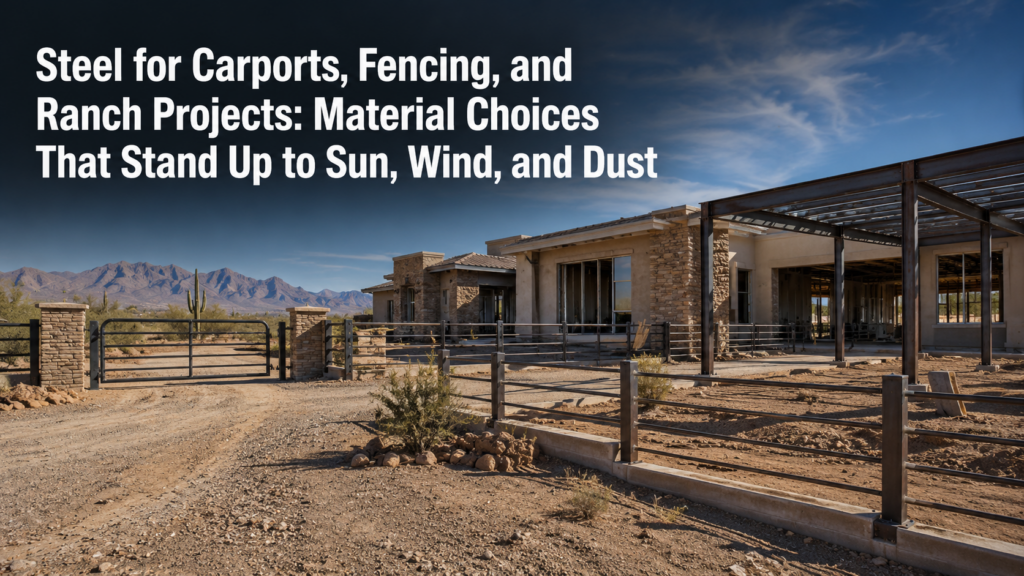
Out on a desert ranch, a fence or a carport does not get a gentle life. It bakes under relentless sun, takes the full force of monsoon wind, and gets sandblasted by dust storms year after year. Build it from the wrong material and it rusts, sags, or leans within a few seasons. Build it right, and it stands for decades with almost no upkeep. That is the whole challenge with steel for ranch projects.
The metal has to be strong enough to hold livestock and span open ground. It has to be tough enough to shrug off wind and dust. And it has to be protected enough to resist rust in a climate that punishes any weak spot. This guide walks through the material choices, pipe, gauge, and finish, that separate a ranch build that lasts from one that fails. Choose well, and the sun, wind, and dust become someone else’s problem.
Why the Desert Is Hard on Ranch Steel
A ranch build faces a specific trio of enemies. The sun brings intense UV and heat that degrade coatings and stress connections. The wind, especially during monsoon season, loads fences and carports hard enough that gauge and bracing become real engineering questions. And the dust, driven by that wind, abrades surfaces and finds every gap. The good news is that dry desert air slows rust once the steel is protected. The catch is that unprotected or under-built steel still fails fast under this combination. Choosing steel for ranch projects means matching strength and protection to all three forces at once, not just one. Get any of them wrong, and the weather finds the weakness. It is worth understanding how metals hold up against rust outdoors before settling on a material.
Key Takeaway: Sun, wind, and dust attack a ranch build together. Steel for ranch projects has to combine strength, the right gauge, and a durable finish, not just one of the three.
Galvanized Pipe: The Backbone of Ranch Fencing
For fencing and livestock enclosures, galvanized steel pipe is the proven workhorse. It is strong, it resists rust through its zinc coating, and it stands up to livestock pressure and weather that would destroy lighter materials.
Pick the Right Diameter
Fence pipe comes in standard diameters, and the right one depends on the job. Lighter pipe around 1-5/8 inch suits fence rails and lighter runs. Heavier pipe from 2-3/8 inch up to 4 inch serves as line posts, brace posts, and corners that carry real tension. Matching the diameter to the load is central to steel for ranch projects.
An undersized post fails at the corner where the fence pulls hardest. The bracing matters as much as the pipe. A corner or end assembly ties the tension of the whole fence line into the ground, so the brace posts have to be set deep and sized to hold. In rocky desert soil, posts often need to sit two to three feet down, and in easier ground even deeper for a game-proof fence. Set the braces well and the fence holds for decades. Skimp on them, and even heavy line pipe eventually leans. This is the detail that separates a fence that lasts from one that sags, and it is worth getting right on any run of steel for ranch projects.
The Standards That Matter
Quality fence pipe meets recognized standards. The ASTM International F1083 specification covers galvanized steel pipe for fence structures. F1043 covers the coating and framework. Together they give a measurable benchmark for the pipe a ranch buys. Pipe that meets these standards is a known quantity, not a gamble.
Key Takeaway: Galvanized pipe is the backbone of ranch fencing. Match the diameter to the load, and look for ASTM F1083 pipe when choosing steel for ranch projects.
Carport and Shelter Steel: Gauge Is Everything
A carport, equipment shelter, or hay cover has to hold its own weight, resist wind uplift, and stand through monsoon gusts. Here the critical choice is steel gauge, the thickness of the metal.
Why Thicker Steel Wins in the Wind
Desert sun and monsoon wind demand stronger steel gauges than a mild climate would. A lighter gauge saves money up front but can buckle or rack under a hard gust. That risk climbs on a wide span or an open-sided structure. For steel for ranch projects that must survive desert wind, a heavier gauge on the frame is cheap insurance against a collapse that costs far more.
Match the Structure to the Load
Wider spans, taller clearances, and open sides all raise the wind load a carport has to handle. The frame steel and the bracing have to match that load. For anything large, an engineered plan should set the spec. A supplier who understands desert wind can help match the gauge and bracing to the structure and the site.
Key Takeaway: For carports and shelters, gauge is everything. Steel for ranch projects should use a heavier frame gauge to resist the monsoon wind that buckles lighter metal.
Finish: The Difference Between Decades and Years
Bare steel does not last in the desert. The finish is what stands between the metal and rust, and it is the single biggest factor in how long a ranch build survives.
Hot-Dip Galvanizing Leads
Hot-dip galvanizing bonds a zinc coating to the steel that sacrifices itself to protect the metal underneath, even if the surface is scratched. The American Galvanizers Association notes that galvanized steel corrodes far slower than bare steel. In dry, low-pollution desert air, that protection lasts a very long time. For fencing, posts, and structural frames, hot-dip galvanized steel for ranch projects is the durability standard.
Paint and Powder for the Rest
Where appearance matters or galvanizing is not practical, quality paint and powder coat systems add a protective barrier and color. The key is matching the finish to the exposure and starting with clean, prepared metal. A finish applied over rust or poor prep fails fast, no matter how good the coating.
Key Takeaway: Finish decides whether steel for ranch projects lasts decades or years. Hot-dip galvanizing leads for fencing and frames in the dusty, sun-baked desert.
Cut to Size: Build Faster With Less Waste
Ranch projects often cover a lot of ground, which means a lot of repeated cuts. Buying raw pipe and cutting every piece by hand is slow, wasteful, and hard on the crew in the heat.
Let the Supplier Do the Cutting
Ordering pipe and steel cut to size means the material arrives ready to build. Think of a long fence line, a run of carport rafters, or a batch of brace assemblies. Cut to size steel for ranch projects removes hours of field cutting and the waste that comes with it. The pieces arrive square and consistent, so the build goes faster and cleaner. On a big ranch job, that time saving is real money.
Key Takeaway: Ranch jobs involve heavy repetition. Ordering cut to size steel for ranch projects removes slow field cutting and waste on long fence lines and carport runs.
Common Ranch Steel Mistakes to Avoid
A few mistakes show up again and again on ranch builds, and each one shortens the life of the structure. Knowing them helps you spec steel for ranch projects that actually lasts.
Undersizing the Corners and Braces
A fence is only as strong as its corners. The line pipe can be modest, but the corner and brace posts carry all the tension. Undersize them, and the fence pulls loose or leans within a season. Size up at every corner and brace, every time.
Skimping on Gauge to Save Money
The lighter gauge is always cheaper on the quote. It is also the first thing to buckle in a monsoon gust. On a carport or shelter, a slightly heavier gauge costs a little more up front and saves a full rebuild after the first big storm. In the desert, gauge is not the place to cut corners.
Ignoring the Finish
Bare or poorly coated steel rusts, even in dry air, wherever the coating is scratched or thin. Reusing old pipe with a failed finish is a common shortcut that backfires. Starting with properly galvanized material, or a sound coating over clean metal, is what buys the decades. A finish is not optional on steel for ranch projects.
Buying Full Lengths and Cutting Everything by Hand
Field cutting a long fence line in the heat wastes time, material, and effort. Ordering cut to size turns that grind into simple assembly. The savings in labor and waste are real on any large ranch job.
Key Takeaway: Undersized corners, thin gauge, a skipped finish, and endless field cutting are the mistakes that shorten a build, so avoid them when speccing steel for ranch projects.
Matching Material to the Project
Different ranch builds call for different steel, and a quick guide helps sort it out. Use this as a starting point, then confirm with a supplier for anything load-bearing or large.
- For fencing and livestock enclosures, galvanized pipe in the right diameter, sized up at corners and braces, is the standard.
- For carports and equipment shelters, focus on frame gauge and bracing matched to the wind load, with a galvanized or coated finish.
- For gates, heavier pipe and solid hinges handle the swing and the abuse. And for hay covers and open shelters, wide-span framing with a heavier gauge resists uplift. In every case, the finish has to match the desert exposure.
Key Takeaway: Fencing, carports, gates, and shelters each call for different steel for ranch projects. Match the pipe, gauge, and finish to what the structure has to do.
Frequently Asked Questions
What size steel pipe is best for ranch fencing?
It depends on the role. Lighter pipe around 1-5/8 inch works for fence rails. Heavier pipe from 2-3/8 inch to 4 inch is used for line posts, braces, and corners that carry tension. Sizing up at corners and braces is where fences hold or fail.
Is galvanized steel worth it for a desert ranch?
Yes. Galvanized steel resists rust through its zinc coating, and in dry desert air that protection lasts a very long time. For fencing, posts, and frames exposed to sun, wind, and dust, galvanizing is the durability standard worth the small added cost.
What steel gauge do I need for a carport in monsoon country?
Desert wind demands a heavier frame gauge than a mild climate. The exact gauge depends on the span, height, and whether the sides are open. An engineered plan is wise for larger structures. A heavier gauge is cheap insurance against wind damage.
Can I get ranch steel cut to size instead of full lengths?
Yes. A full-service supplier can cut pipe and steel to length and fabricate to your specifications, so the material arrives ready to build. On long fence lines and repeated carport parts, cut to size steel saves significant time and waste.
Conclusion
A ranch build lives a hard life of sun, wind, and dust, and the steel you choose decides whether it stands for decades or fails in a few seasons. Galvanized pipe in the right diameter anchors fencing. A heavier gauge carries carports through the wind. A hot-dip galvanized finish holds off the rust. Cut to size ordering turns a big job into a manageable one. The principle is simple. Match the strength, the gauge, and the finish to all three desert forces at once, and confirm the plan for anything large. Do that, and steel for ranch projects delivers exactly what a rancher needs. It is a build that goes up once and stands without constant repair, so the weather becomes someone else’s problem.
Build Your Ranch Project With Endura Steel
Endura Steel supplies galvanized pipe, structural steel, and carport and fencing material, cut to size and fabricated, for ranchers and builders across California, Arizona, and Nevada. More than 55 years of desert experience stands behind every order. Tell us the project and the site, and get steel built to stand up to the sun, wind, and dust.
- Call us: Ft. Mohave, AZ at (928) 754-7000, Hesperia, CA at (760) 244-5456, or Thousand Palms, CA at (760) 343-3100.
- Request a quote online: Use our contact form and include your project, pipe sizes, gauge, and finish.
- Email your account manager: Send your material list or drawings, and get pipe and steel cut to size and ready to build. Explore our metal products or our cut to size and fabrication services to get started. Your success is our success.
Key Takeaway: Whether you call, request a quote online, or send a material list, good steel for ranch projects comes down to the right pipe, gauge, and finish for the desert. Match the material to the job before you build.
