
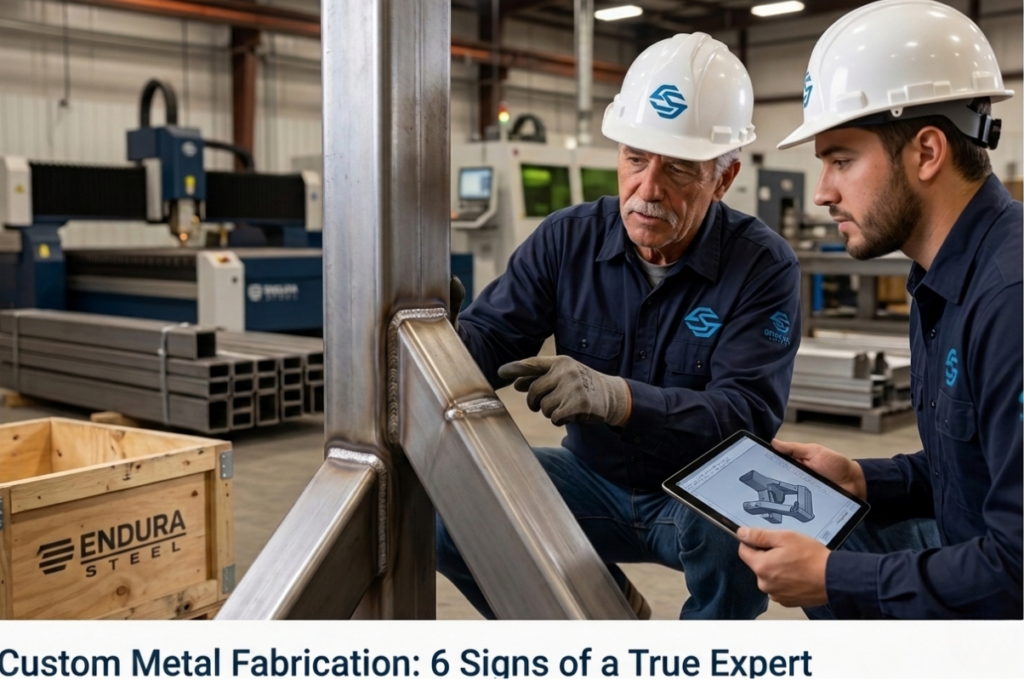
A steel plate that arrives a quarter inch out of square does not look like a crisis. It looks like a small adjustment, a few minutes with a grinder, a hole re-drilled on site. Then it happens on the next plate, and the next, and by the end of the week a crew has burned a full day correcting work that should have arrived right. That is the quiet tax of poor fabrication, and it lands on the schedule and the labor budget long after the invoice is paid. The fix is not more field labor. It is custom metal fabrication done correctly upstream, so components show up cut, drilled, and bent to spec and ready to install. The financial case is well established.
The American Welding Society has authored more than 350 welding and fabrication standards, including the D1.1 Structural Welding Code for steel, one of the most-referenced codes in the world, which means the quality bar for fabrication is defined and measurable.
This guide breaks down the 6 signs that separate a true custom metal fabrication expert from a shop that simply cuts metal.
Why Fabrication Quality Decides the Budget
On most projects, raw material is a known cost. The variable that quietly decides profitability is what happens to that material before it reaches the crew. When parts fit the first time, installation flows. When they do not, every misfit ripples into rework, re-cuts, and idle labor. Pulling that work into a controlled shop is one of the clearest levers a project controls.
Material standards underpin the whole process: ASTM International develops the consensus specifications that define each grade’s chemical and mechanical properties, so an expert fabricator can confirm the metal matches the design before a single cut is made. Custom metal fabrication is where that value is won or lost. The six signs below are what to look for in a fabricator who protects the schedule instead of quietly draining it.
Key Takeaway: Because consensus material and welding standards define what good looks like, the quality of custom metal fabrication shapes a project’s outcome more than the raw material ever does.
Sign 1: Tolerances Held to a Published Standard
Precision Is Measurable, Not a Promise
Any shop can claim to be precise. An expert fabricator names the standard it works to. Structural steel fabrication tolerances in the United States are defined by the American Institute of Steel Construction, and a serious shop can tell you which tolerance class a job falls under before the first cut. A fabricator who cannot point to a published tolerance is asking for trust without evidence. One who can is telling you that fit-up at assembly is engineered, not hoped for.
Why a Quarter Inch Matters
Tolerance stacking is real. A small deviation on one part compounds across a connection, and what looks acceptable on a single plate becomes a binding bolt pattern across an assembly. Tight, verified tolerances in custom metal fabrication are what keep that stacking from reaching the field. The cost of getting it wrong is not the re-cut. It is the crew standing idle while the re-cut happens. On a connection with multiple bolt holes, a deviation of even a sixteenth of an inch per hole can add up to a pattern that will not seat, forcing a field ream or a return to the shop. Expert fabricators control that risk by working from the engineering drawing’s stated tolerance band and verifying critical dimensions before a part ships, rather than discovering the problem at assembly when the cost of fixing it has multiplied.
Key Takeaway: A true custom metal fabrication expert works to a named tolerance standard, because precision you cannot measure is just a sales pitch.
Sign 2: In-House Control of Every Operation
Single Accountability Beats a Vendor Chain
When cutting, drilling, and bending happen under one roof, one party owns the result. When those steps are farmed out to subcontractors, accountability fractures, and a single late or wrong handoff stalls the whole order. In-house custom metal fabrication means a specification change does not have to travel through three vendors before it reaches the saw. It reaches the fabricator directly, and the turnaround stays tight.
Adapting to the Drawing That Changes
Engineering drawings change, often late. A fabricator with full in-house control can re-cut and re-drill on short notice. A shop dependent on outside processors cannot, and the project absorbs the delay. When a revised connection detail lands 72 hours before installation, the difference between a shop that controls its own saws and presses and one that has to re-queue with a subcontractor can be the difference between holding the schedule and losing a week. In-house custom metal fabrication compresses that response time because the revision goes straight to the floor.
Key Takeaway: In-house custom metal fabrication puts one shop on the hook for the result, so changes move fast and accountability never gets lost between vendors.
Sign 3: The Right Process for Each Cut
Laser, Plasma, Waterjet, and Shear
Precision cutting is not one method. Laser, plasma, waterjet, and mechanical shearing each suit different thicknesses, tolerances, and edge requirements. An expert matches the process to the part rather than forcing every job through the same machine. Waterjet leaves a clean edge with no heat-affected zone, which matters for some alloys.
Plasma is fast and economical on heavier plate. Laser delivers tight tolerances and a fine edge on thinner material, while mechanical shearing handles straight, high-volume cuts efficiently. The right call depends on the material, the thickness, and the spec, and a knowledgeable fabricator explains the tradeoff before the job runs rather than defaulting to whatever machine is open.
Edge Quality Is Part of the Spec
A cut is not finished when the part separates from the plate. Edge condition, squareness, and finish all affect how the piece welds and fits. Custom metal fabrication that ignores edge quality creates downstream work that surfaces at the weld.
A heat-affected zone left by an aggressive thermal cut can change how an edge behaves under welding, and a rough or out-of-square edge can prevent a tight joint. The best fabricators treat edge finish as part of the deliverable, not an afterthought a welder discovers on site.
Key Takeaway: Expert custom metal fabrication chooses the cutting process to fit the part, because the wrong method shows up later as a bad edge or a failed fit.
Sign 4: Material Knowledge, Not Just Machine Time
Knowing When to Switch Grades
A fabricator who only runs machines will cut whatever grade is on the order. A fabricator who understands metal will flag when A36 is being asked to do A572 work, or when 304 stainless should be 316 for a corrosive setting. That guidance prevents a callback that machine time alone never catches.
Material judgment is the difference between a vendor and a partner in custom metal fabrication.
Matching Metal to the Southwest
Environment drives material choice. Desert heat, coastal salt air, and chemical exposure each demand different grades and finishes. A fabricator with regional experience folds that into the recommendation before the order is cut, not after the coating fails.
A part destined for an inland desert frame faces very different stresses than one bound for a coastal installation, and the right finish or alloy chosen up front is far cheaper than a corrosion callback two seasons later. That kind of judgment turns a fabricator from a vendor into a genuine partner on the project.
Key Takeaway: The best custom metal fabrication pairs machine precision with material judgment, catching a wrong grade before it becomes a field failure.
Sign 5: Documentation and Certification
Traceability When the Project Demands It
Public works, structural, and many commercial jobs require documented material traceability. Mill test reports and material certifications prove a grade is what the order called for. An expert fabricator provides them as a matter of course, not as a special request. Custom metal fabrication without documentation is a gamble on any job where an inspector will ask for paperwork. A mill test report ties a specific heat of steel to its chemical and mechanical properties, certifying compliance with the relevant ASTM International specification, which is exactly what a project engineer needs to confirm the delivered material matches the design. On jobs where that paperwork is required and missing, the material can be rejected outright, and a rejection at delivery is far more expensive than requesting certs at the time of order.
Quality Records That Hold Up
Beyond mill certs, a disciplined shop keeps records of its processes and checks. That paper trail is what stands behind the work when a question arises months later, and it is a marker of a fabricator that takes the responsibility seriously.
Key Takeaway: Documentation and mill certs are non negotiable in custom metal fabrication for any job where traceability will be inspected.
Sign 6: Speed Without Sacrificing Accuracy
The Schedule Upside of Getting It Right
Fabricated steel arrives ready to erect, with no waiting on forming, shoring, or curing. The schedule advantage is large. The American Society of Civil Engineers reports that shop-fabricated steel systems can speed construction by as much as 43% over cast-in-place concrete. That advantage only holds if the parts are right. Speed that produces misfit components is not speed, it is rework deferred to the field.
Rush Capability for the Real World
Projects do not always allow a comfortable lead time. A capable fabricator offers rush turnaround for the drawing that changes 72 hours before installation, without letting accuracy slip under the pressure.
Key Takeaway: Real custom metal fabrication speed means parts that arrive fast and fit right, because accuracy sacrificed for pace just moves the delay downstream.
How to Order Custom Fabrication the Right Way
Clear specifications are the foundation of a clean fabrication order. The more precise the request, the fewer surprises at delivery. A complete order generally includes material specs, fabrication details, project logistics, and engineering documentation.
For material, state the metal type, grade and alloy, and form (plate, sheet, bar, angle, channel, or beam).
Fabrication details should cover exact dimensions, cut angles or bevels, hole locations and patterns, bend angles and radii, and quantities.
When it comes to the project itself, share the delivery location, site access, required date, and any staging needs.
Finally, the documentation package should include shop drawings or CAD files, tolerance requirements, and any certifications needed. A strong fabricator reviews the package, confirms feasibility, and sets a delivery schedule that aligns with the project timeline before any metal is cut.
Key Takeaway: Precise specifications drive precise results, so a complete custom metal fabrication order covers material, fabrication, logistics, and documentation up front.
Frequently Asked Questions
What tolerances should a fabricator hold?
A capable shop works to the structural steel tolerances defined by AISC, and tightens its process for critical applications that demand more. Discuss specific tolerance needs during ordering so the shop can confirm capability and quote accurately.
Can one fabricator handle both small custom orders and large runs?
Yes. A well-equipped fabricator handles single specialty pieces and high-volume production with the same quality standards. Order size should not change the precision.
What if I am unsure which material is best?
Describe the conditions: loads, environmental exposure, corrosion risk, and temperature range. A fabricator with deep material knowledge recommends the grade and finish that balance performance, longevity, and cost.
Do fabricators provide material certifications?
A reputable shop provides mill test reports and material certifications whenever a project requires documented traceability. Confirm this need at the time of order.
Conclusion
Custom metal fabrication isn’t a commodity, even though it is often priced like one. The difference between a shop that cuts metal and an expert that engineers fit-up shows up in the schedule, the labor budget, and the inspection paperwork. The six signs (published tolerances, in-house control, the right cutting process, material knowledge, documentation, and speed with accuracy) are the markers worth checking before the first order. The practical takeaway for any contractor is to vet the fabricator as carefully as the spec, because precise components that fit the first time protect the timeline far more than a slightly lower price per pound ever could.
Start Your Fabrication Project With Endura Steel
Endura Steel has supplied and fabricated metal for contractors, fabricators, and project leads across California, Arizona, and Nevada for more than 55 years. From precision cut to size and fabrication to custom rebar bent to engineering drawings, the goal is the same: components that arrive ready to install. Put that experience to work on your next job.
- Call us: Hesperia, CA at (760) 244-5456, Thousand Palms, CA at (760) 343-3100, or Ft. Mohave, AZ at (928) 754-7000.
- Request a quote online: Use our contact form and include your grade, dimensions, tolerances, and site date.
- Your success is our success.
Key Takeaway: Whether you call, request a quote online, or email shop drawings, expert custom metal fabrication should make ordering easy and delivery predictable, so reach out before your next job, not after a misfit.
