
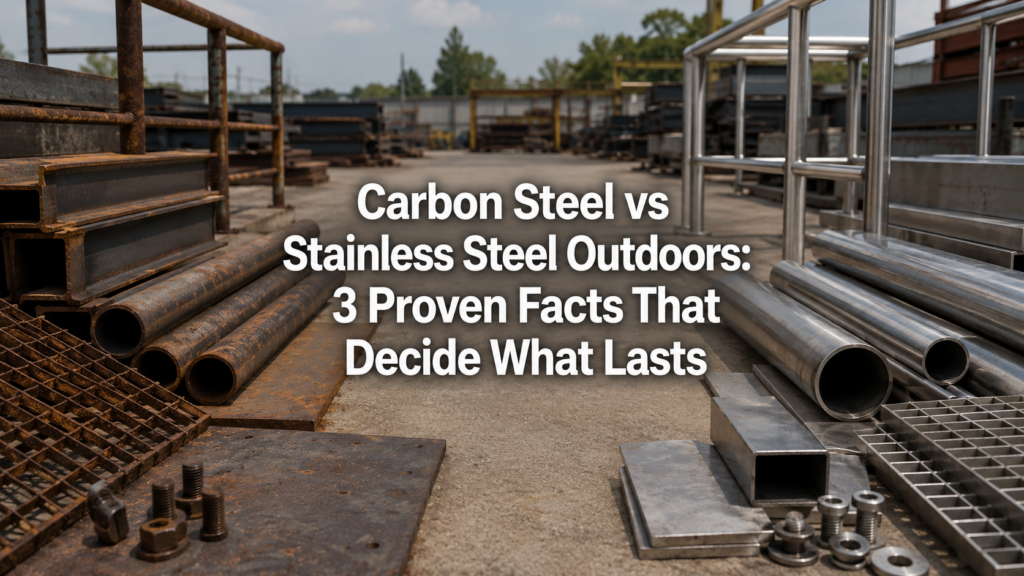
Spec the wrong metal for an outdoor build and the mistake does not show up at install. It shows up two summers later as rust streaks down a column, a seized fastener, or a railing that has to be replaced years before anyone budgeted for it. The question of carbon steel vs stainless steel outdoors looks simple on paper, stainless resists corrosion and carbon steel does not, but that easy answer hides the part that actually decides cost: the environment the metal lives in.
That nuance matters more in the Southwest than almost anywhere else. The same plate that would rust through quickly on a humid Gulf Coast can last for decades in dry desert air. Choosing between the two metals is not about which is universally better. It is about matching the material, and its finish, to the real conditions on the site. This guide breaks down carbon steel vs stainless steel outdoors in practical terms, so the choice protects the budget instead of draining it.
The Core Difference: Why One Rusts and One Resists
Both metals start with iron, and iron oxidizes when it meets moisture and oxygen. That reaction is rust. The difference is what each metal does about it. Stainless steel contains at least 10.5% chromium. That chromium reacts with oxygen to form an invisible, self-healing chromium oxide layer that shields the iron underneath, which is why stainless resists corrosion without a coating.
Carbon steel has no such layer. Left bare, it rusts whenever moisture and oxygen reach the surface. This is the heart of the carbon steel vs stainless steel outdoors decision. Stainless protects itself. Carbon steel has to be protected, through galvanizing, paint, or another coating, or it has to live somewhere dry enough that corrosion stays slow. The protection a coating provides is dramatic: hot-dip galvanized steel corrodes at roughly one-thirtieth the rate of bare steel in the same environment, because the zinc forms its own adherent, protective patina (American Galvanizers Association).
Key Takeaway: In carbon steel vs stainless steel outdoors, stainless defends itself with a self-healing chromium layer, while carbon steel relies on a coating or a dry climate to hold rust at bay.
The Southwest Factor: Why Dry Air Changes the Math
Here is what most generic comparison guides miss. Corrosion is driven by moisture, specifically by how long a metal surface stays wet, a measure engineers call time-of-wetness. In a humid or coastal climate, that surface stays damp for hours, and carbon steel pays the price. The Southwest is the opposite. Low relative humidity and infrequent rain mean a steel surface dries fast and stays dry. Corrosion of zinc coatings slows substantially in dry, low-pollution air, and inland regions with low humidity represent close to the best-case environment for coated steel longevity.
What This Means for Your Material Budget
In practical terms, the desert tilts the carbon steel vs stainless steel outdoors equation back toward carbon steel for many applications. A properly galvanized carbon steel member in dry Arizona air can deliver a very long service life, often at a fraction of the cost of stainless. That is not a blanket endorsement of carbon steel. It is a reason to weigh the specific site rather than defaulting to the more expensive metal out of habit.
Key Takeaway: Dry desert air shortens time-of-wetness, which slows corrosion and makes coated carbon steel a far stronger contender outdoors in the Southwest than it would be on a humid coast.
Where Carbon Steel Wins
Carbon steel earns its place on a large share of Southwest outdoor projects, especially when cost and strength matter and the right protection is applied. Carbon steel is generally stronger and harder than stainless, and it costs significantly less per pound. For structural members, frames, and heavy load-bearing components, that strength-to-cost advantage is hard to ignore. Paired with hot-dip galvanizing, carbon steel gains a sacrificial zinc layer that protects it for decades in dry conditions.
When Carbon Steel Is the Right Call
Carbon steel, properly coated, is often the smart choice for structural framing and support members, fence posts and railings away from sprinkler spray, equipment frames and skids, and general fabrication where the part will be painted or galvanized. In each case, the dry climate and a sound coating do the work that stainless would otherwise be paid a premium to do. The caveat is maintenance. Coated carbon steel rewards periodic inspection. A scratch through galvanizing or paint is a doorway for rust, and catching it early is the difference between a touch-up and a replacement.
Key Takeaway: Carbon steel wins outdoors when strength and cost lead, the part is properly galvanized or painted, and the site stays dry, which describes a large share of Southwest builds.
Where Stainless Steel Wins
Stainless earns its premium where corrosion risk is high, maintenance access is hard, or appearance is part of the spec. In those settings, the carbon steel vs stainless steel outdoors decision swings clearly toward stainless. Even in the dry Southwest, some exposures stay wet or chemically aggressive. Anywhere water collects or recurs, near irrigation, pools, fountains, wash-down areas, or kitchens, the dry-climate advantage disappears and corrosion resistance becomes essential.
When Stainless Is Worth the Premium
Stainless steel is the right call for railings and fixtures near water features or irrigation, food service and sanitary applications, chemical exposure or wash-down environments, architectural facades where finish and longevity both matter, and any component where future maintenance access is limited or costly.
For the most demanding corrosive settings, marine-grade 316 stainless, with added molybdenum, offers the highest resistance. Stainless also wins on the maintenance ledger. It needs no coating to maintain, so over a long service life the higher upfront cost can offset the labor of inspecting and recoating carbon steel.
Key Takeaway: Stainless steel justifies its higher price outdoors when moisture recurs, chemicals are present, maintenance access is limited, or finish and longevity are both part of the spec.
Do Not Forget the Third Option: Coated Carbon Steel
The carbon steel vs stainless steel outdoors question is often framed as two choices, but the most cost-effective answer in the Southwest is frequently a third: carbon steel with the right protective system. Hot-dip galvanizing bonds a zinc coating metallurgically to the steel and adds sacrificial protection, so if the surface is scratched, the zinc corrodes first and spares the steel underneath.
For structural steel a quarter inch thick or greater, the ASTM International A123 specification sets a minimum zinc coating thickness, which gives a measurable, inspectable standard for the protection a project is buying. The longevity that buys is substantial. Industry testing shows hot-dip galvanized structural steel can deliver on the order of 72 to 73 years to first maintenance even in the most corrosive industrial atmosphere, and dry, low-pollution settings extend that further still (American Galvanizers Association). In the dry Southwest, that is a long, low-maintenance service life at carbon steel prices.
Matching the Coating to the Exposure
Not every coating suits every job. Galvanizing excels for structural and buried applications. Paint and powder systems add color and a barrier for less aggressive exposures. The right choice depends on the part, the exposure, and the finish requirement, and it should be settled before fabrication, not after the first sign of rust.
Key Takeaway: In the Southwest, coated carbon steel is often the budget-smart middle path, delivering stainless-like longevity in dry air at a fraction of the material cost.
The Real Cost Comparison: Upfront vs Lifetime
Price per pound is the number that gets compared on the quote, and on that line carbon steel wins comfortably. Stainless steel carries a meaningful premium because of its chromium and nickel content. But the purchase price is only the first cost a project pays. The honest carbon steel vs stainless steel outdoors comparison runs over the full service life. Carbon steel costs less to buy, but a coated carbon steel member rewards periodic inspection and the occasional touch-up or recoat, and that is labor and access spread across decades. Stainless costs more to buy, but needs no coating maintenance at all.
When the Math Favors Each Metal
For accessible, ground-level, or easily reached components in dry conditions, carbon steel usually wins the lifetime math, because inspection and touch-up are cheap when the part is easy to get to. For components that are hard or expensive to reach, a roof structure, a tall facade, a fixture over water, the calculation flips. There, the labor to maintain coated carbon steel over the years can quietly exceed the upfront premium of stainless, and the maintenance-free metal becomes the cheaper choice over time. This is why a blanket rule never works. The right answer depends on access, exposure, and how long the structure needs to last, which is exactly the kind of judgment a regional supplier brings to the spec.
Key Takeaway: Carbon steel usually wins the lifetime cost math for accessible parts in dry conditions, while stainless can win it for hard-to-reach components where maintenance labor outweighs the upfront premium.
How to Choose: A Practical Framework
Cutting through the carbon steel vs stainless steel outdoors debate comes down to a handful of honest questions about the site and the part. Walk through them before specifying metal. First, how wet does this location get, and how often. Constant or recurring moisture pushes toward stainless. Dry, fast-drying exposure opens the door to coated carbon steel. Second, are chemicals or salts present. If so, stainless, and possibly 316 grade. Third, how accessible is the part for future maintenance. Hard-to-reach components favor stainless to avoid recoating labor.
Fourth, does appearance matter. A polished, lasting finish favors stainless. Fifth, what is the budget across the full service life, not just the purchase. Carbon steel costs less up front but carries maintenance, while stainless costs more up front but little after. Answering those five questions resolves most material decisions. When the answers conflict, that is the moment to talk to a metal supplier who knows the local climate rather than guessing.
Key Takeaway: Five questions, moisture, chemicals, maintenance access, appearance, and full-life budget, resolve most carbon steel vs stainless steel outdoors decisions before a single part is ordered.
Frequently Asked Questions
Does carbon steel rust faster in the desert than other climates?
No. The opposite is true. Carbon steel corrosion is driven by how long the surface stays wet, and the dry Southwest keeps surfaces dry, so corrosion proceeds more slowly than in humid or coastal regions, especially when the steel is galvanized or painted.
Is stainless steel always the better choice outdoors?
Not always. Stainless resists corrosion without a coating, but it costs more and is generally less strong than carbon steel. In dry climates and away from recurring moisture or chemicals, properly coated carbon steel often delivers comparable longevity at a lower cost.
What grade of stainless is best for outdoor use?
For most outdoor applications, 304 stainless performs well. For high-corrosion settings, such as near water, chemicals, or wash-down areas, marine-grade 316 stainless adds molybdenum for greater resistance and is the more durable choice.
How long does galvanized carbon steel last outdoors in a dry climate?
In dry, low-pollution inland conditions, hot-dip galvanized steel can deliver a very long service life with minimal maintenance, because low humidity dramatically slows the corrosion of the zinc coating. Exact longevity depends on coating thickness and exposure.
Conclusion
The honest answer to carbon steel vs stainless steel outdoors is that neither metal wins universally. Stainless protects itself and excels where moisture, chemicals, or limited maintenance access raise the stakes. Carbon steel, properly coated, delivers strength and value, and the dry Southwest climate works in its favor in a way it never would on a humid coast. The real skill is matching the metal and its finish to the specific site. Get that right and the structure lasts without overpaying. Get it wrong and the cost arrives later as rust, rework, and early replacement.
Talk Through Your Project With Endura Steel
Endura Steel has supplied carbon steel, stainless steel, and coated metal to contractors, fabricators, and project leads across California, Arizona, and Nevada for more than 55 years. That regional experience is exactly what it takes to match the right metal and finish to a Southwest site. Before you specify, talk it through with a metal expert.
- Call us: Hesperia, CA at (760) 244-5456, Thousand Palms, CA at (760) 343-3100, or Ft. Mohave, AZ at (928) 754-7000.
- Request a quote online: Use our contact form and include your application, exposure, and finish requirements.
- Email your account manager: Send your project details and timeline, and get a material recommendation built around your actual site conditions. Explore our carbon steel and stainless inventory or learn more about cut to size and fabrication. Your success is our success.
Key Takeaway: Whether you call, request a quote online, or email your project details, the smartest move in any carbon steel vs stainless steel outdoors decision is to match metal and finish to the site, so reach out before you specify, not after the rust shows.
