
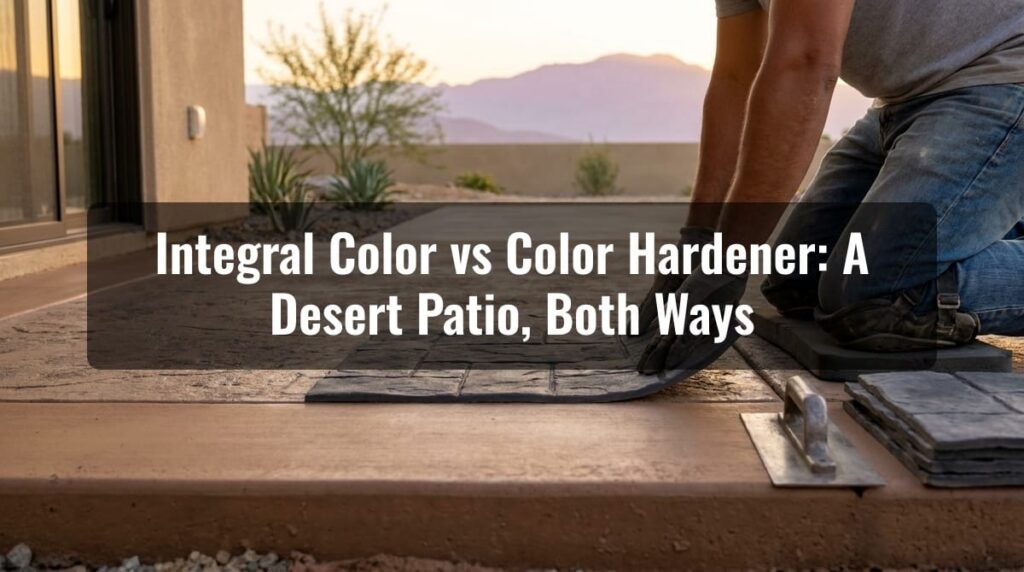
It’s July in the Coachella Valley. You have a 400 sq ft stamped patio on the schedule, the ready-mix is ordered, and the release agent’s own data sheet says to apply it at temperatures between 55 and 80°F. When you weigh integral color vs color hardener for a slab like this, the method matters less than the window you have to work in. We worked one 20 x 20 patio both ways from the Brickform and Solomon data sheets: 2.5 to 5 bags of integral, or 4 to 5 pails of hardener.
Integral color vs color hardener: the short answer for desert slabs
Integral color is mixed into the whole load at the plant, so it adds almost no labor on the slab. Color hardener is a dry shake you broadcast (spread by hand across the wet surface) and float into the fresh concrete, so it gives richer color but asks more of your finishers. In a desert summer, both methods have to fit inside the release window, and hardener packs more steps into it.
| Integral color | Color hardener | |
|---|---|---|
| Where the color is | Through the whole slab, mixed in the truck | A surface layer, up to about 1/8 in per an engineer quoted by Concrete Network |
| Labor added | Little to none, per Solomon Colors | Two broadcast and float passes; Solomon says it “requires more time, effort, and skill on the part of the finishers” |
| Color strength | Subtle hues, less intense, per Concrete Network | More vivid surface color (Solomon) |
| Consistency risk | Harder to match across big, multi-truck jobs | Can drift between lots and needs bleed water (the water that rises to the top of fresh concrete) to work in |
| Best fit | Flatwork, steps, vertical and complex faces | Flatwork: Solomon says hardener is “generally limited to flatwork” |
| Curing bans | No plastic or wet burlap (Solomon) | No plastic sheeting, membrane paper or water misting (Brickform) |
On price, Concrete Network says integral color may add 10 to 30% over plain concrete, with labor largely unchanged. Hardener’s extra cost is mostly finishing time: Solomon says it “requires more time, effort, and skill on the part of the finishers”, and Concrete Network quotes engineer Jeff Potvin: spreading hardener usually takes about 6 man-hours per 500 sq ft. For this 400 sq ft patio, that’s roughly 5 man-hours.
Key Takeaway: Steps, curbs and vertical faces point to integral, since hardener is a flatwork method.
One 400 sq ft patio, worked both ways
Here is the job: a 20 x 20 ft patio, 4 in thick. That’s 400 sq ft x 0.333 ft = 133 cu ft, divided by 27 = about 4.9 cu yd. We round the order up to 5 yd for the math below. Your own margin is your call.
Integral color: dose times the cement on your mix ticket
Solomon recommends an integral dose of 2 to 4% of the total cementitious weight in the mix, per its ready-mix tech sheet. Cementitious means the cement plus any powders that act like cement, such as fly ash. Below 1% can look washed out, 7% is the saturation point, and above 10% can cut strength.
So the real dose is that percentage times the cement weight on the plant’s mix ticket. Solomon’s dry color chart turns it into 25 lb bags:
- 2% dose: 1 bag per 2 yd. For 5 yd, that’s 2.5 bags (about 62.5 lb).
- 4% dose: 1 bag per yd. For 5 yd, that’s 5 bags (125 lb).
Do the math backward and the chart’s 1 bag per 2 yd at 2% implies about 625 lb of cement per yard (12.5 lb divided by 0.02). On a leaner mix, or one with fly ash, the bag count comes out lower. Ask the plant to calculate it from your actual ticket before you order 2.5 or 5 bags, and ask how it handles a half bag. Fly ash or other pozzolans (powders that react with cement and replace part of it) also change the color you get, as Concrete Network points out. For a test panel, Concrete Network notes integral mock-ups need at least 3 cu yd to show the real color. A wheelbarrow sample won’t match the truck.
Color hardener: pails for the same slab
Brickform’s Color Hardener data sheet gives the rates in 60 lb pails:
- Darker colors: 60 lb or more per 100 sq ft. For 400 sq ft, 240 lb, or 4 pails.
- Light pastels: up to 60 lb per 80 sq ft. For 400 sq ft, 300 lb, or 5 pails.
- A lightly sandblasted finish: at least 90 lb per 100 sq ft, so 360 lb, or 6 pails.
The first pass alone takes at least 40 lb per 100 sq ft, per the same sheet. On this patio that’s 160 lb, or about 2.7 pails, before the second pass goes down.
Cross-check the totals with the field rule of 1/2 to 1 lb per sq ft from Concrete Network: 200 to 400 lb on this patio. The pail math lands right inside it.
Watch out for the looser figure on a Sweets product listing, which says one 60 lb bucket covers 90 to 120 sq ft. At the 120 sq ft end you’d order 4 pails (240 lb), short of the 300 lb (5 pails) a pastel needs at the data-sheet rate. Order from the data sheet rate instead. Two more habits help: buy pails from the same lot or mix pails together, since Brickform says color can drift between lots, and check the pail label, because the data sheet we used dates from 2011.
Release agent and retarder: you pick one release
Liquid Release and Antique Release are alternatives, not a pair. Use Liquid for a single color. Use Antique for a two-tone look over either base.
- Liquid Release: 1 gal covers about 150 to 250 sq ft, per Brickform’s Liquid Release sheet. For 400 sq ft, plan on 1.6 to 2.7 gal.
- Antique Release: generally 3.5 lb or more per 100 sq ft, per the Antique Release sheet, so 14 lb or more here. It works over hardened or integral color, but never as the main color.
- Evaporation retarder: Brickform’s Evaporation Retarder is mixed 1 part to 9 parts water and covers 200 to 400 sq ft per diluted gallon. One coat on this slab is 1 to 2 diluted gallons, or about 0.1 to 0.2 gal of concentrate. Plan for more if you reapply between passes.
| 400 sq ft, 4 in slab (5 yd order) | Integral color | Color hardener |
|---|---|---|
| Color | 2.5 bags (2%) to 5 bags (4%), 25 lb each, if the mix matches the chart; confirm from the mix ticket | 4 pails (dark) to 5 pails (pastel), 60 lb each |
| Release (pick one) | Liquid: 1.6 to 2.7 gal, or Antique: 14 lb or more | Liquid: 1.6 to 2.7 gal, or Antique: 14 lb or more |
| Evaporation retarder | Optional, about 0.1 to 0.2 gal concentrate per coat | Same per coat, often more than one coat |
| Base mix notes | Same mix design every truck, 4 in slump, no calcium chloride | At least 5 1/2 sacks cement per yd, 4 in max slump, no calcium chloride |
The base mix notes come from the Solomon and Brickform sheets. Slump is a measure of how wet and runny the mix is: a higher number means a looser mix. Solomon also asks for at least 100 drum turns and 10 minutes of mixing, with the mixer at least 30% loaded.
Key Takeaway: Before you order, get the cement weight from the plant’s mix ticket for integral, and check the pail label rate for hardener.
The 55 to 80°F problem: what a summer pour changes
Both Brickform release sheets give the same window: apply at temperatures between 55 and 80°F. Now compare that with the valley. Palm Springs’ normal daily high sits at 109°F from July 10 to August 14, based on NOAA normals reported by KESQ. The nights don’t help much either: the 1991-2020 normal low for July 1 is 76.2°F, per Extreme Weather Watch.
On a normal mid-summer day, then, the air is inside the window only briefly around first light. On warm nights it may not drop below 80°F at all. Check the hourly forecast against 55 to 80°F before you book the truck. If there’s no workable window, move a hardener job to spring or fall, or call the branch or Brickform about working outside it.
The NRMCA hot weather guide (CIP 12) adds rules that apply to both methods. Heat shortens set time, so avoid the hottest part of the day, and don’t sprinkle water on the slab to help finishing or add water to concrete more than 1.5 hours old. The guide also lists windbreaks, sunscreens, fogging and evaporation retardants.
What heat does to a hardener pour
Hardener depends on bleed water to wet out, meaning it has to draw up enough moisture from the slab before it can be floated in. Brickform says to broadcast only after excess bleed water is gone, with a first pass of at least 40 lb per 100 sq ft, floated and not troweled, then a second pass for full coverage. No water added to the surface. Solomon warns hardener may not work in low-bleed-water conditions, and Concrete Network says it can crust in dry, windy weather and needs 7 to 10 minutes to wet out before you float. That’s two passes plus stamping, all inside the window. Brickform says its evaporation retarder can be reapplied between passes.
What heat does to an integral pour
Integral color has fewer steps, but it punishes water. Solomon’s integral dos and don’ts say added jobsite water will noticeably lighten the color. On hot days, dampen the subgrade lightly, pour early and avoid wind. If you need more slump, ask the plant for a water reducer instead of adding water (Solomon). For set time in heat, NRMCA lists set-retarding admixtures.
One storage note for desert yards: Brickform says not to store Antique Release above 120°F, so keep pails shaded and out of closed vehicles in summer.
Key Takeaway: If the release can’t go down between 55 and 80°F, don’t stamp that day.
Curing colored concrete: skip the wet methods, use the maker’s cure-and-seal
On colored concrete, skip the wet methods and use the color maker’s approved cure-and-seal. Here’s why. General hot-weather guidance from NRMCA says to cure with wet burlap and plastic, or a membrane compound, for at least 3 days. The wet methods are where it clashes with the color makers. For hardener, Brickform’s sheet rules out plastic sheeting, membrane paper and water misting. On integral work, Solomon’s guidance rules out plastic and wet burlap. NRMCA’s membrane-compound option still fits, as long as the compound is the color maker’s approved cure-and-seal.
The day-one cure product and the 28-day final sealer are separate steps, so plan to buy both. Fogging is a gray area: NRMCA lists it to slow evaporation during finishing, but the color sheets don’t address it, so ask the maker before you fog a colored slab.
Color takes time to settle. Solomon says integral color needs 2 to 4 weeks to cure out. On Brickform’s sheet, sealing comes after 28 days, with foot traffic kept off for 24 hours and vehicles off for 5 days.
Long-term color holds up best with a maintained sealer. Solomon’s dry integral colors are ASTM C979 compliant, per Solomon, and Concrete Network advises making sure any color hardener meets ASTM C979. Solomon calls its integral colors “sunfast”, and Brickform calls its hardener “non-fading”. Those are maker claims. Solomon also says carbon black can dissipate over time and calls for sealer upkeep, and Brickform says to seal after 28 days.
Key Takeaway: Buy the maker’s cure-and-seal along with the color, so it’s on site for day one, and keep the final sealer for day 28.
Decision tool: count the hours between 55 and 80°F first
Step 1: Count your window. Look at the hourly forecast for pour morning and count how many hours fall between 55 and 80°F. In July in the valley, that may be a short stretch around sunrise, or none.
Step 2: List what each method must fit in those hours.
- Integral: the truck, the release, the stamping.
- Hardener: all of that, plus 2 broadcast passes with 7 to 10 minutes of wet-out each, and about 5 man-hours just to spread the hardener on 400 sq ft.
Step 3: Set your crew against that load. A crew of two puts in 2 man-hours per clock hour, so 5 man-hours of hardener work alone takes them about 2.5 hours. A bigger, experienced flatwork crew gets through it faster.
Result: A short window or a crew of two points to integral color, or to a new date. A good window and a skilled crew make hardener a fair choice.
| Job type | Lean toward | Why |
|---|---|---|
| Color on only part of the slab | Color hardener | Solomon says it can color parts of a job from one load of plain concrete |
| Steps, vertical faces or curbs | Integral color | Hardener is generally limited to flatwork |
| Multi-truck or multi-day pour | Integral from one plant and one mix, or hardener to blend | Solomon suggests hardener to even out multi-day integral pours |
You can also use both. Concrete Network puts it this way: “the best is a combination of both, which adds to the cost.” For a two-tone look, Brickform’s sheet allows Antique Release over either method. One more caution from Solomon: poorly applied hardener can delaminate, meaning the colored top layer peels away in thin sheets. If nobody on the crew has done it, integral is the safer first job.
What we carry and what to ask the branch
Our Concrete Stains & Finishes page lists color hardeners for stamped concrete plus acrylic, epoxy and urethane sealers from Solomon Colors and Brickform. Brickform Liquid Release and stamps like Classic Wood, Roman Sanded Slate and Rough Stone are on our Brickform and Solomon items page. For floats and edgers to work the hardener in, see our concrete tools. For integral color, ask the branch what they can get you. Bring your square footage, thickness and color, and we’ll help you check the counts.
Get Your Color Order Right With Endura Steel
- Call Thousand Palms at (760) 343-3100 for Coachella Valley jobs.
- Call Hesperia at (760) 244-5456 or Ft. Mohave at (928) 754-7000.
- Get a Quote online and tell us the slab size and method.
Your success is our success.
Frequently asked questions
Does integral color or color hardener fade in the sun?
Solomon’s dry integral colors are ASTM C979 compliant, and Concrete Network advises making sure any color hardener meets ASTM C979. Solomon calls its integral colors sunfast and Brickform calls its hardener non-fading; those are manufacturer claims. Brickform says to seal after 28 days, and Solomon says carbon black can dissipate over time and calls for sealer upkeep.
Can you use color hardener over integral color?
Yes. Concrete Network says “the best is a combination of both, which adds to the cost,” and Solomon suggests hardener to blend multi-day integral pours. Brickform also allows Antique Release over either integral or hardener colored concrete for a two-tone look.
How long should stamped colored concrete cure before sealing?
Brickform’s sheets say to seal after 28 days, then keep foot traffic off for 24 hours and vehicles off for 5 days. Solomon notes integral color needs 2 to 4 weeks for the color to cure out. Until then, use the color maker’s approved cure-and-seal: Brickform rules out plastic sheeting, membrane paper and water misting on hardener, and Solomon rules out plastic and wet burlap on integral color.
Why did my integral colored concrete come out lighter or blotchy?
Added jobsite water lightens integral color, and calcium chloride accelerator can cause light and dark areas, according to Solomon. Changes in the mix design between trucks, fly ash content, short mixing, or curing under plastic can also cause uneven color. Keep the same mix, ask the plant for a water reducer instead of adding water, and mix at least 100 revolutions and 10 minutes.
Does color hardener make concrete stronger?
Brickform describes hardener as forming a denser, more abrasion and impact resistant surface layer. Strength numbers you see online, like the 1,000 to 2,000 psi gain in a 2010 Concrete Decor column, are installer opinions rather than test data. Treat it as a tougher wear surface, not a structural upgrade.
