
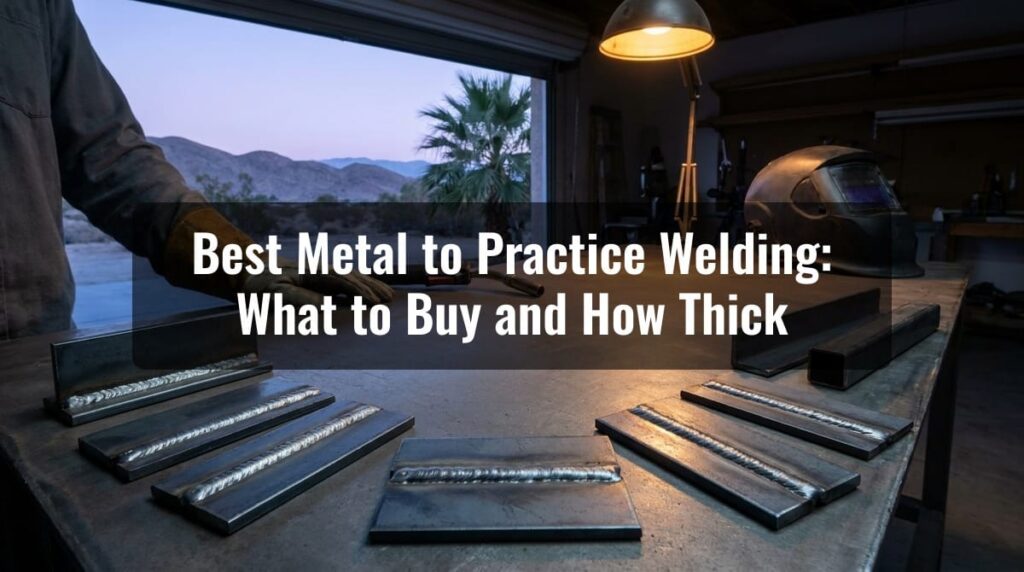
The best metal to practice welding is clean mild (low-carbon) steel, in a thickness your machine can actually melt in one pass. On a 120V machine that means 16 to 14 gauge strip first, with 1/8 inch flat bar about as thick as it goes. Stick and 240V machines start on 3/16 to 1/4 inch flat bar. Either way, cut it into coupons (short practice pieces).
Knowing what to ask for at the counter is where people get stuck. One review on the Endura Steel homepage says it plainly: “Came in not looking for much. Just some metal to practice my welds at home.”
Why Mild Steel Is the Best Metal to Practice Welding
Low-carbon steel has less than 0.3% carbon. The Missouri Welding Institute describes it as ductile and weldable with almost any equipment you own.
A36 is the common structural grade of mild steel, and a summary of the ASTM spec notes it is readily welded by all welding processes. If you want a known grade for test practice, ask about A36 availability. For plain bead and joint practice, ordinary hot rolled bar works fine.
The bigger choice is the surface:
- Hot rolled (HR): the most common and usually the cheapest. It carries a dark, flaky skin called mill scale. Hobart Brothers lists your options: buy shot-blasted or cold rolled steel, blast it yourself, or grind the scale off where you weld.
- HR pickled and oiled (P&O) strip: hot rolled strip that has been treated with acid to remove surface impurities, then oiled. Our carbon steel bar page lists it next to flat, square and angle bar. Wipe the oil off before you strike an arc.
- Cold rolled (CR): no mill scale, so it is a good pick for TIG practice, where clean metal matters most.
Hobart notes that the manganese and silicon in E7018 rod act as deoxidizers that let it weld through some dirt and mill scale. Grind anyway while you practice, so you learn what a good puddle looks like on bright metal. More on the two mill processes in our post on hot rolled vs cold rolled steel and when to use each.
Key Takeaway: Ask for plain carbon steel, hot rolled for cheap seat time, P&O or cold rolled when you want a cleaner surface, and grind the weld zone either way.
How Thick? Match the Steel to Your Machine
Buy steel your machine can melt in one pass: about 1 amp for every .001 inch of thickness, so a 90 amp rating handles about .090 inch. Go much thinner and you burn holes. Go much thicker and you are past what one pass can do.
The amp rule that sets your thickness
Miller Electric’s MIG guide gives a simple starting rule: each .001 inch of steel thickness needs about 1 amp. So 1/8 inch (.125) wants about 125 amps. Miller also lists solid wire ranges: .023 inch wire runs about 30 to 130 amps, .030 inch about 40 to 145, and .035 inch about 50 to 180. Bigger machines often run .045 inch wire, at about 75 to 250 amps.
Worked example (an example, not a rating for your machine): a typical 120V hobby MIG like the Hobart Handler 140EZ puts out 30 to 140 amps and is rated 90 amps at a 30% duty cycle. Duty cycle is the share of time the machine can weld at that output before it has to rest and cool. By Miller’s rule, 90 amps is about .090 inch of steel in one pass. The same product page lists 24 gauge to 1/4 inch in its spec table, while its description says it welds up to 3/16 inch mild steel. Both figures sit well above the .090 inch the amp rule gives for its rated output.
Manufacturers’ standard gauge thicknesses for steel sheet run 16 ga at 0.0598 in, 14 ga at 0.0747 in, 11 ga at 0.1196 in, 10 ga at 0.1345 in, and 7 ga at 0.1793 in. By the amp rule, 16 ga needs about 60 amps and 14 ga about 75, both inside that 90 amp rating. 11 ga needs about 120 amps and 1/8 inch about 125. That is past the 90 amp rating and close to the machine’s 140 amp top, so on a 120V box treat them as a stretch at the top of its range and keep those beads short.
Practice Thickness by Process and Machine
| Process / machine | Practice thickness | Shape and piece size to buy | Where the number comes from |
|---|---|---|---|
| 120V solid-wire MIG | 16 to 14 ga for one-pass beads inside a 90 A rating; 11 ga to 1/8 in only with short beads near max output | 16 ga strip first, then 2 in flat bar in 1/8 in, cut 4 to 6 in long | Miller: about 1 A per .001 in; Hobart 140EZ: 90 A at 30% duty |
| 120V flux-core | 16 ga to start; 1/8 in once 16 ga goes well, near max output | 16 ga strip for the first exercise, then 1/8 in flat bar | Lincoln manual: 16 ga practice plate with .035 in NR-211-MP wire; 140EZ takes .030 to .035 in flux wire |
| 240V or dual-voltage MIG | 3/16 in for one-pass beads near 180 A; 1/4 in with .045 in wire or per your machine’s chart (example from the amp rule) | 2 in flat bar in 3/16 and 1/4 in, cut 4 to 6 in | Miller starting points: about 1 A per .001 in; .035 in wire 50 to 180 A (180 A is about .180 in, near 3/16 in); .045 in wire 75 to 250 A |
| Stick, 1/8 in 6011 or 7018 | 3/16 in or heavier; 1/4 in is a good default | 2 in flat bar in 1/4 in, cut 4 to 6 in; some 1/8 in for later | Lincoln manual: 3/16 in plate, 1/8 in E6011 at 90 to 125 A; Hobart: 1/8 in 7018 at 90 to 150 A |
| TIG (DC, steel) | Our suggestion: 16 ga to 1/8 in, sized by the amp rule | Cold rolled or P&O strip, wiped clean before each session | Miller TIG basics: clean off grease and oil; 3/32 in tungsten for general work up to 220 A; keep the puddle about 1/4 in wide |
| Weld test prep | 3/8 in, typical of many plate tests | 3/8 in flat bar or plate plus 1/4 in backing strap | Welding Tips and Tricks: typical 3G (vertical-position plate) test, 22.5 degree bevels, 1/4 in backing |
On stick, a handy rule from the Navy Steelworker training manual says never use a rod with a diameter larger than the metal you are welding. A 1/8 inch rod on 16 gauge breaks that rule, which is why stick practice starts thicker. Miller says 7018 gives a smooth, quiet arc with little spatter, while 6010 has a tight arc that can be hard for beginners.
On thin sheet, Lincoln warns that 16 gauge and lighter can warp and burn through from heat buildup. Learn travel speed there, then move up.
Weld test layouts vary. Check the current AWS D1.1 edition or ask your test facility for the exact plate, bevel and backing they use before you buy.
Every number above is a starting point. The chart inside your machine’s door wins.
Key Takeaway: Divide your machine’s comfortable amps by 1,000 to get a one-pass thickness, then buy a little thinner and a little thicker than that.
A Starter Buy List by Shape
Everlast gives the simplest practice list we have seen: flat bar about 2 inches wide in at least 1/8 and 1/4 inch thickness, cut into 4 to 6 inch pieces for joints and positions. Bevel the 1/4 inch pieces when you are ready for open-root work, meaning a butt joint with a small gap and no backing.
Coupon math (example): one foot of bar is 12 inches. That gives 3 pieces at 4 inches or 2 at 6 inches, minus a little for each saw cut. A 10 foot length works out to about 30 coupons at 4 inches, or about 20 at 6 inches.
Then add shapes as your practice grows:
- Strip or sheet, 16 ga. For 120V MIG and flux-core machines: your first one-pass butt and lap joints. Ask about HR P&O strip.
- Flat bar, 2 in x 1/8 in and 2 in x 1/4 in. Your main stock for beads, butt, lap and T joints.
- Angle, 1-1/2 to 2 in legs. Stands on its own, handy for T and corner joints and vertical-up runs.
- HR square tube with a thin wall, 14 to 11 ga. Teaches heat control on thin walls, the same skill gates and frames need.
These sizes are suggestions to ask about, not a stock list. Call the branch to see what fits.
You may need less steel than you think. Welding Tips and Tricks calls padding beads one of the best MIG practice drills, because they take very little metal and very little prep time.
Key Takeaway: Buy by machine. On a 120V box, start with 16 to 14 ga strip, with 11 ga to 1/8 inch flat bar as the stretch. For stick or 240V, start with 3/16 to 1/4 inch flat bar. Add angle and thin-wall tube once your flat beads look even.
Drops, Cut-Offs and Randoms: Buying Cheap Practice Steel From a Yard
Every steel yard makes leftovers. When a customer orders a piece cut to length, the end that remains is a drop or cut-off. “Randoms” are odd lengths that don’t fit a standard order. For a beginner, these pieces are often good practice steel. One review on the Endura Steel homepage mentions good prices on cut-offs and randoms, so it is fair to ask.
Expect mixed sizes and shapes, with mill scale and some surface rust on hot rolled pieces, so plan to grind.
How to ask: call the branch and ask whether drops or cut-offs are available, and say what you need. Something like “plain carbon steel only, no galvanized or coated pieces, 16 to 14 ga strip for a 120V machine” or “flat bar around 3/16 to 1/4 inch for stick” saves everyone time.
If you buy a length instead, we can cut it. Our Cut to Size service runs a shear, a chop saw station and a band saw station in the yard. Material thicker than 1/4 inch goes to the plasma and beam cutter at Smith Ironworks, our sister company. The page also notes that cutting charges may apply for larger quantities or for plasma and beam cutting. For 3/8 inch test practice, ask whether flat bar cut to length is the simpler route.
One thing Everlast warns against: building a practice pile out of rebar, old bed rails or exhaust tubing. Fresh, mostly rust-free steel lets you see your own weld clearly.
Key Takeaway: Ask for plain carbon drops in your thickness range, say no to coated pieces, and have longer bar cut into coupons at the yard.
Metals to Leave Out of Practice, and Why
Leave galvanized, painted or coated scrap, stainless and aluminum out of early practice. Read your machine manual and your rod or wire safety sheets too.
- Galvanized steel. The American Galvanizers Association says the zinc coating should be removed at least 1 to 4 inches from either side of the weld, on both sides of the piece. Breathing zinc fumes can cause metal fume fever, with symptoms like a sweet taste, dry throat, fatigue, nausea and chills.
- Painted, plated, oily or coated scrap. The OSHA fact sheet on welding fumes says to clean surfaces of any coating that could create a toxic exposure. It also notes that welding outdoors or in open spaces does not guarantee good ventilation. In late October’s cooler garage weather, keep the door open, but keep your head out of the plume.
- Stainless steel, for now. OSHA notes that chromium in stainless turns into hexavalent chromium, a hazardous fume, during welding. It also needs different filler and gas, such as ER308L wire with an argon-based gas per Baker’s Gas.
- Aluminum, for now. The American Welding Society explains that aluminum’s oxide layer melts at a higher temperature than the metal under it, and the metal pulls heat away fast. It needs AC TIG or a spool gun and 100% argon. It can wait until your steel beads look even.
Key Takeaway: Weld bare carbon steel only until your basics are steady.
What to Practice First, and What to Buy at Each Step
- Bead on plate and padding beads on the thickness your machine fits: 16 to 14 ga strip on 120V, 3/16 to 1/4 inch flat bar on stick or 240V.
- Butt, lap and T joints on coupons of that same stock, 4 to 6 inches long.
- The other end of the range: thin-wall square tube for heat control, or 1/8 inch bar as the stretch on a 120V machine.
- Vertical and overhead on angle, which props itself up in any position.
- Test plate in 3/8 inch, only if you are training for a certification.
Once your fillet welds (the corner welds in a T or lap joint) look the same every time, put them to work. Our guide to steel for carports, fencing and ranch projects covers the materials for first real builds.
Bring Your Machine’s Numbers to Endura Steel
Tell us your process and your machine’s amp range. We will help you pick flat bar, angle or square tube that fits, and you can ask about A36 availability, drops and cutting it into coupons.
- Call a branch: Hesperia (760) 244-5456, Thousand Palms (760) 343-3100, or Ft. Mohave (928) 754-7000.
- Get a Quote through our contact form with your sizes and lengths.
- Already working with us? Contact your account manager.
Your success is our success.
Frequently asked questions
What thickness of steel should a beginner practice welding on?
Your machine decides: 16 to 14 gauge on a 120V welder, 3/16 to 1/4 inch on stick or 240V. Miller’s rule of thumb is about 1 amp per .001 inch, so 1/8 inch needs around 125 amps. A 120V machine rated near 90 amps stays inside its rating on 16 to 14 gauge, and 1/8 inch pushes it close to its limit. A stick welder with 1/8 inch rod wants 3/16 inch or thicker.
Is hot rolled or cold rolled steel better for welding practice?
Hot rolled is usually cheaper and fine for practice, but it has mill scale that you should grind off where you weld. Cold rolled and pickled and oiled strip have a cleaner surface, which helps most with TIG. Wipe the oil off P&O strip before welding.
Can a 120V flux-core welder weld 1/4 inch steel?
Not by the amp math. The Hobart Handler 140EZ lists 1/4 inch in its spec table, yet its description says up to 3/16 inch, and it is rated 90 amps at a 30% duty cycle. Miller’s rule of about 1 amp per .001 inch puts 90 amps at roughly .090 inch per pass. For practice on a 120V machine, 16 to 14 gauge sits inside that rating and 1/8 inch is about the most it should take on.
Is it OK to practice welding on rebar?
It is a poor pick for learning. Everlast calls rebar, old bed rails and exhaust tubing less than ideal practice material and suggests fresh, mostly rust-free steel instead. Its list is simple: 2 inch flat bar in 1/8 and 1/4 inch, cut into short pieces.
Can you practice welding on galvanized steel?
Leave it out of practice. The American Galvanizers Association says the zinc should be removed 1 to 4 inches from each side of a weld, on both sides, and zinc fumes can cause metal fume fever. Bare carbon steel teaches the same skills without that risk.
