
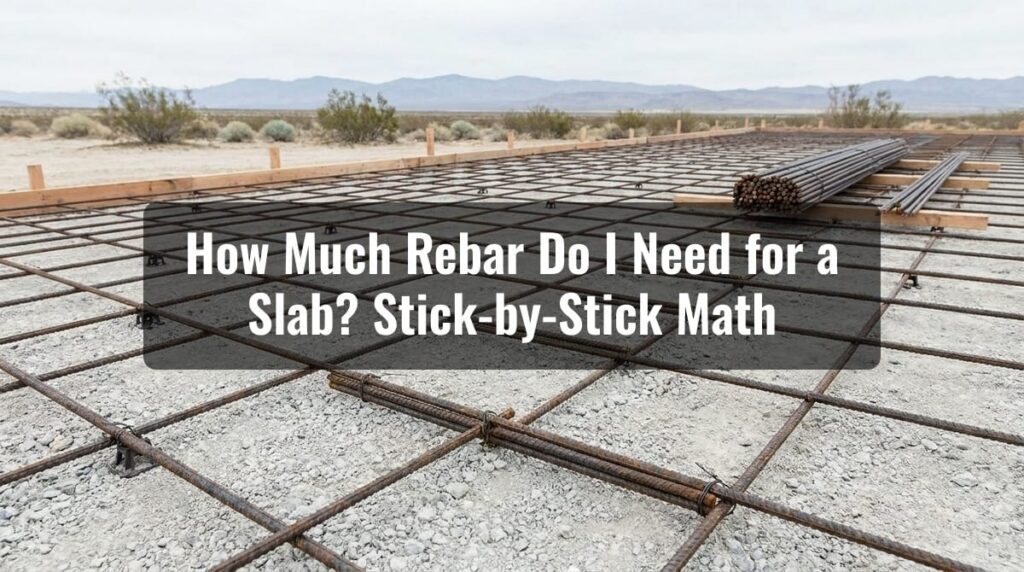
Type “how much rebar do I need for a slab” into two calculators and you can get two answers, both short. An example 30 x 40 ft shop slab with #4 bars at 18 inches each way needs 98 twenty-foot sticks, about 1,309 lb, while two popular calculator methods say 83 or 92.
The fix is to count the bars in each direction, add laps wherever a run is longer than your stick, build a cut list, and only then turn it into sticks and pounds. Bar size, spacing, lap length and cover come from your plans, your engineer or your building department. Once you have those, the math below gets you from slab size to a number you can order.
The four-step method
- Find the steel area. Bars stop short of the forms so they end up inside the concrete, not touching dirt or wood. Subtract that edge clearance from each side. We use 3 inches in the example; your plans set the real cover. (The California Residential Code’s 3 inch rule for steel cast against earth is a footing rule, not a slab number.)
- Count bars per direction. Divide the span the bars are spaced across by the spacing, round up, then add one bar for the far edge. This is the method Inch Calculator lays out.
- Fit each run to the stick. A run longer than your stick needs a lap splice. Work out the pieces for one run, then multiply.
- Build the cut list, then weigh it. Pair offcuts so short pieces share a stick. Count sticks, then convert feet to pounds and crossings to ties.
Key Takeaway: Count per run, not per total. Dividing total feet by 20 skips the laps and the drop (the leftover offcuts you can’t use), and both are real steel you pay for.
How much rebar do I need for a slab of 30 x 40 ft?
This is an example input, not a recommendation. A shop slab, 30 ft wide and 40 ft long, with #4 bars at 18 inches (1.5 ft) each way and bars stopped 3 inches from the forms. How spacing gets chosen is a separate question; here it is just the number on the drawing.
Take 3 inches off each side and the steel covers 29.5 x 39.5 ft.
- Long bars (running the 40 ft way) are spaced across the 29.5 ft width: 29.5 / 1.5 = 19.67, round up to 20 spaces, plus 1 = 21 bars at 39.5 ft = 829.5 ft.
- Short bars (running the 30 ft way) are spaced along the 39.5 ft length: 39.5 / 1.5 = 26.33, round up to 27 spaces, plus 1 = 28 bars at 29.5 ft = 826 ft.
Net steel with no laps: 829.5 + 826 = 1,655.5 linear feet. At 0.668 lb per foot for #4, that is about 1,106 lb. The grid has 21 x 28 = 588 crossings, which matters later for ties.
Most calculators stop here. Rebar comes in stock lengths, so runs this long have to be fitted to the stick.
Where the laps fall on 20 ft sticks
Rebar mills cut to stock lengths. Nucor says most sizes come in 20, 40 and 60 ft pieces, shipped in bundles. Supply yards carry what their customers use, so ask the branch which lengths it carries before you plan around one. The example uses 20 ft sticks, the shortest of the stock lengths Nucor lists.
Codes prefer fewer splices. For footings and stem walls, CRC R403.1.3.5.4 says reinforcement “shall be the longest lengths practical” and sends lap length to Table R608.5.4(1). Designed concrete follows ACI 318-19 Table 25.5.2.1, as summarized in this ICC inspector study guide. It bases laps on development length: the length of bar needed to grip the concrete, which the designer calculates. A Class A lap is the greater of 1.0 times that length or 12 in., and it applies only under strict conditions. A Class B lap is the greater of 1.3 times that length or 12 in., and it covers all other cases. Development length depends on bar size, grade, concrete strength, cover and spacing. So there is no single lap length that is “code” for every slab.
For the example we assume a 24 inch lap. Your drawing’s number goes here instead.
- 39.5 ft run: two sticks with one lap give 38 ft, which is short. So it takes three pieces and two laps: 39.5 + 2 + 2 = 43.5 ft of bar, cut as 20 + 20 + 3.5.
- 29.5 ft run: two pieces and one lap: 29.5 + 2 = 31.5 ft, cut as 20 + 11.5.
The laps add 21 x 4 ft + 28 x 2 ft = 140 ft, or 8.5% on top of the net 1,655.5 ft. That puts 1,795.5 ft of bar in the slab.
A common field practice is to flip the short piece to the opposite end on every other bar, so the laps don’t all line up across the slab. ACI’s Class A lap only applies when no more than half the bars are spliced in the same zone, which is one reason staggering comes up. Whether you stagger, and how, is the designer’s call.
The cut list: 98 sticks or 119
The 40 ft direction uses 42 full sticks and 21 pieces of 3.5 ft. The 30 ft direction uses 28 full sticks and 28 pieces of 11.5 ft. That is 70 sticks used whole. The question is how many sticks the 49 short pieces eat.
A stick can only hold one 11.5 ft piece (two would need 23 ft), so the 28 pieces of 11.5 ft need 28 sticks no matter what. The trick is to cut the 3.5 ft pieces from what’s left on those same sticks.
The rule works on any slab. List the short pieces longest first. Start a stick with the longest piece, then fill the rest of it with the next pieces that fit. Any piece longer than half a stick needs its own stick, and those pieces set the minimum count.
| Cut pattern (20 ft stick) | Sticks | Pieces per stick | Drop per stick | Total drop |
|---|---|---|---|---|
| Used whole | 70 | one 20 ft | 0 ft | 0 ft |
| 11.5 + 3.5 + 3.5 | 10 | three | 1.5 ft | 15 ft |
| 11.5 + 3.5 | 1 | two | 5 ft | 5 ft |
| 11.5 only | 17 | one | 8.5 ft | 144.5 ft |
| Total | 98 | 119 pieces cut | 164.5 ft |
That is 98 sticks, 1,960 ft, about 1,309 lb. The drop is 164.5 ft, or 8.4% of what you bought. In this layout 98 is the floor, because the 28 pieces of 11.5 ft already need 28 sticks of their own.
Now say the crew cuts each short piece from a fresh stick as they go. That is 70 + 28 + 21 = 119 sticks, or 2,380 ft. Same slab, 21 more sticks. If you are cutting on site, Endura Steel’s post on cutting rebar with less waste covers the tools and safety side.
What if the lap is longer? With an example 30 inch lap, the pieces become 20 + 20 + 4.5 and 20 + 12. Laps now add 21 x 5 ft + 28 x 2.5 ft = 175 ft (10.6%). The cut list is still 98 sticks: 21 sticks cut 12 + 4.5, and 7 sticks cut 12 alone. The lap changed the bar in the slab and the drop, but not the stick count here. On another slab size it could tip a run into an extra piece, which is why the designer’s lap goes in before you count. If the designer bans short end pieces or limits where laps can fall, redo the cut list.
Why rebar calculators give different answers for the same slab
Calculators disagree because they make different assumptions about edge clearance, the extra bar, laps and offcuts. Run the example slab through the common methods and you get five answers:
| Method | What it does | 20 ft sticks |
|---|---|---|
| Total feet / 20, as on Omni Calculator | 1,655.5 / 20 = 82.8, round up. No laps, no drop. | 83 |
| Add 10%, as on Inch Calculator | 1,655.5 x 1.1 = 1,821 ft, / 20 = 91.05, round up. | 92 |
| Multiply the two counts, as written on Raken | 360 in. / 18 = 20, 480 in. / 18 = 26.7 rounded to 27, 20 x 27. | 540 (a rough crossing count, not bars) |
| Planned cut list | Laps placed, offcuts paired. | 98 |
| Unplanned cutting | Each short piece from its own stick. | 119 |
The differences come from a short list of choices:
- Edge clearance. Some methods subtract it, some use the full slab size.
- The extra bar. Dividing span by spacing gives spaces. You need one more bar than spaces.
- Rounding. Rounding total feet to sticks assumes every offcut gets used. Rounding per run doesn’t.
- Laps. Most calculators leave them out. Inch Calculator says bars must overlap on long runs but gives no length.
- Drop. Pieces that can’t be reused are still steel you bought.
- Multiplying counts. 20 x 27 gives roughly the number of places bars cross (the real grid here has 588), not a bar count.
Here the flat 10% came up 6 sticks short. The laps alone were 8.5% of net, and the drop was 8.4% of what was bought. Together, the 1,960 ft order is 304.5 ft, about 18%, over the 1,655.5 ft net. A 10% rule can work on a slab where every run fits the stick. It can’t cover two laps per bar.
Key Takeaway: A calculator is a fair check on net linear feet. For the order, count per run with your lap and your stick length.
Stick length changes the order
Same slab, same 1,655.5 net feet, three stick lengths:
| Stick length | How it cuts | Sticks | Feet bought | Laps to tie |
|---|---|---|---|---|
| 20 ft | Cut list above | 98 | 1,960 | 70 (21 bars x 2 + 28 bars x 1) |
| 40 ft | 21 cut to 39.5 (0.5 ft drop), 28 cut to 29.5 (10.5 ft drop) | 49 | 1,960 | 0 |
| 60 ft | 21 cut to 39.5 (20.5 ft drop), 14 cut into two 29.5 ft bars | 35 | 2,100 | 0 |
With 40 ft sticks both runs fit in one piece, so there are no laps at all. You buy the same 1,960 ft as the 20 ft cut list, but there are half as many sticks to handle and no splices to tie. With 60 ft sticks the count drops to 35, but the long bars leave 20.5 ft of drop each, so you buy 2,100 ft (about 1,403 lb).
Longer sticks need a longer truck, more hands and room on site. Ask the branch which lengths it carries and can deliver, then plan the cut list around that.
Pounds, ties and chairs
Rebar is often quoted and weighed by the pound, so convert your feet. These are the standard nominal weights, from Engineering ToolBox:
| Bar size | Diameter | Weight (lb/ft) | One 20 ft stick (lb) |
|---|---|---|---|
| #3 | 3/8 in. | 0.376 | 7.5 |
| #4 | 1/2 in. | 0.668 | 13.4 |
| #5 | 5/8 in. | 1.043 | 20.9 |
| #6 | 3/4 in. | 1.502 | 30.0 |
For the example: 1,655.5 ft net is about 1,106 lb, 1,795.5 ft in place is about 1,199 lb, and the 1,960 ft order is about 1,309 lb.
Ties. Crossings equal bars one way times bars the other: 21 x 28 = 588. Tying every crossing means 588 ties; every other crossing means 294. Which one is right is set by the spec or the placing drawings. CRSI describes tie types, including the snap tie used on flat bar mats, but does not set a frequency. Common practice is to tie each lap as well. A tie wire twister saves a lot of wrist on a grid this size.
Chairs. For welded wire, ACI 302.1R, as quoted in an American Concrete Institute FAQ, says not to lay it on the ground and pull it up during the pour, and says supports must be close enough that foot traffic can’t force it out of place. The same thinking applies to a bar mat. Chair spacing for bars comes from the spec or the chair maker.
When the drawing or an engineer sets the numbers
The plans, the engineer or the building department set bar size, spacing, lap length, cover, tie frequency and grade. Which code applies depends on the building and the city or county; a home and a commercial shop fall under different codes. The building department or the engineer’s drawings will say. Permit drawings always win over a calculator or an article.
This method also counts only a flat grid. Thickened edges, grade beams, footings, dowels into an existing slab and corner bars all add steel it does not count. Take those off the drawing and add them to the cut list as their own lines.
Send Us Your Bar List
October is a good month to pour a shop or garage slab, with cooler mornings than the summer months. Before you book the truck, send Endura Steel your bar size, run lengths and cut list, or just the plan sheet. We cut rebar to length through our cut to size service, and our rebar line includes fabricated rebar: “We can cut, bend, and shape rebar to your project’s exact engineering specifications.” Ask which stick lengths your branch carries and about grade availability, and use the Rebar Ordering Checklist to get grade, tags and delivery details on the order.
- Call Hesperia at (760) 244-5456 for the High Desert.
- Call Thousand Palms at (760) 343-3100 for the Coachella Valley.
- Call Ft. Mohave at (928) 754-7000 for the Mohave Valley and Nevada.
- Get a Quote through the contact form with your cut list attached.
Your success is our success.
Frequently asked questions
How many 20 ft sticks of rebar do I need?
Work it out per run, not by dividing total feet by 20. For each bar length, figure how many 20 ft pieces and laps it takes, list the short leftover pieces, then pair those short pieces on shared sticks. The stick count is the full sticks plus however many sticks the paired short pieces fill.
How much extra rebar should I order for waste?
There is no fixed percentage that fits every slab, because the extra depends on laps and drop. In a 30 x 40 ft example with #4 at 18 inches on 20 ft sticks, laps added 8.5% and the order ended up about 18% over net linear feet. A flat 10% allowance came up 6 sticks short on that slab.
How long does a rebar lap need to be?
Your plans or designer set it. Under ACI 318-19, most tension laps are Class B, the greater of 1.3 times the development length or 12 inches, and the development length depends on bar size, grade, concrete strength and cover. For footings, the California Residential Code points to Table R608.5.4(1).
How much does #4 rebar weigh per foot?
#4 rebar weighs 0.668 lb per foot, the standard nominal weight for a 1/2 inch bar. A 20 ft stick weighs about 13.4 lb. Multiply your total feet ordered by 0.668 to get the order weight.
How many rebar ties do I need for a slab?
Start with the crossings: bars one way times bars the other way. A grid of 21 by 28 bars has 588 crossings, so 588 ties if every crossing is tied or 294 if every other one is. The spec or placing drawings say which, and laps need ties too.
