
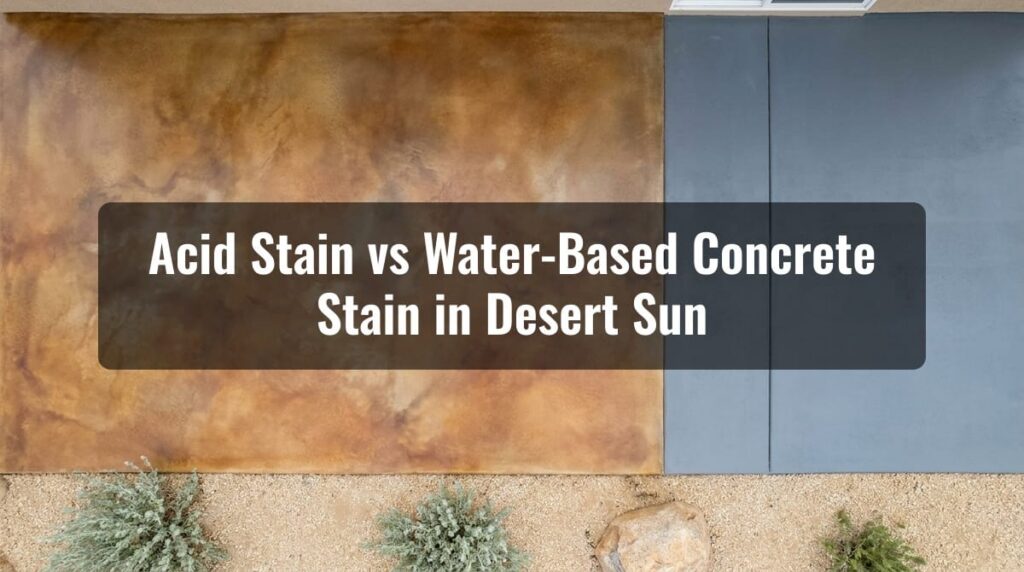
Acid stain vs water-based concrete stain on a patio in full desert sun comes down to time as much as looks. Both work outdoors, and both must be sealed. Acid stain gives mottled earth tones that Brickform calls a permanent color change. But it is a dawn-start job: a 4 to 6 hour reaction, then neutralizing and a pressure wash, and three of its colors darken where water stands. Water-based stain gives a wider, more even palette, including greens and blues rated for outdoors. It needs no neutralizing and can be ready for sealer in a couple of hours, but it depends on that sealer to last.
Late September still brings highs in the mid-90s to low 100s across the high desert, the Coachella Valley and the Colorado River valley.
Acid stain vs water-based concrete stain, data sheet to data sheet
Our two examples are Brickform’s Blush-Tone Acid Stain technical information sheet and its ARTesian water-based stain sheet, both dated April 2023. Blush-Tone uses mineral salts that react with the free lime at the surface of the slab. That lime is left in the concrete as the cement cures; ConcreteNetwork calls it hydrated lime, or calcium hydroxide. ARTesian is a penetrating stain with no acid in it, sold as an alternative to reactive stains. Other brands differ, so read the sheet for yours.
| What the sheet says | Acid stain (Blush-Tone example) | Water-based stain (ARTesian example) |
|---|---|---|
| How it colors | Chemical reaction with lime in the slab; permanent color change | Pigment that soaks into the pores; no reaction |
| Air temperature to apply | 50F to 90F | 50F to 90F |
| Coverage | About 200 to 300 sq ft per gallon | About 250 to 300 sq ft per gallon |
| Standard colors | 10 | 20 |
| Concrete age | Fully cured; the guide spec says about 28 days minimum | Cured is best, but use on fresh concrete is “not uncommon” |
| Wait time | Let it react at least 4 to 6 hours | Dries; a sunny, warm exterior may be ready for sealer in a couple of hours |
| Neutralize and wash | Yes: Neutra Clean, scrub, then pressure wash outdoors | No: broom the dry slab and blow or vacuum off loose pigment |
| Outdoor color limits | Jade, Turquoise and Olive can darken or blacken with standing or subgrade water | Greens and blues “can be used outdoors” |
| VOC | 0 | Zero |
| Sealer | Seal all stained surfaces (guide spec) | “Must be sealed” |
| After sealing | 24 hours for foot traffic, 5 days for vehicles | 24 hours for foot traffic, 5 days for vehicles |
| Who it is made for | Licensed contractors trained in its use; the safety data sheet limits it to professional users | Licensed contractors trained in its use |
What the table means for looks: acid stain gives a mottled finish in a mostly earthy range of tans, browns, terra cottas and soft blue-greens, as ConcreteNetwork describes it. Water-based stain has a broader range and is more predictable, though Concrete Decor notes it may not give as much depth. Neither stain hides cracks, blemishes or discoloration; both Brickform sheets say so.
Key Takeaway: Both stains share the same 50F to 90F window and both must be sealed; acid adds a 4 to 6 hour reaction plus neutralizing and a pressure wash.
The late-September clock: how much of a desert morning each stain needs
Acid stain needs most of a desert morning: a 4 to 6 hour reaction, then neutralizing, scrubbing and a pressure wash. Water-based stain needs about two hours to dry on a sunny, warm day before you broom it. Both sheets stop at 90F air temperature, so the real question is which job fits before the air gets there. Here is how often the three nearest NOAA stations pass that line in September, from the 1991-2020 normals for Palm Springs, Needles and Barstow-Daggett.
| NOAA station (near) | September average high | September average low | Days at 90F or above |
|---|---|---|---|
| Palm Springs (Thousand Palms) | 101.8F | 74.4F | 27.6 |
| Needles (Ft. Mohave) | 102.6F | 77.3F | 28.6 |
| Barstow-Daggett (nearest hourly station for the high desert) | 96.3F | 66.0F | 25.8 |
Barstow-Daggett is the nearest NOAA station with hourly normals for the high desert, and its hourly normals for September 23 show how fast it closes. NOAA lists standard time; we added an hour for daylight time:
- 7 am: about 65F
- 10 am: about 79F
- 11 am: about 83F
- Noon: about 87F
- 1 pm: about 89.5F
- 2 pm: about 91F
On a hot day (the 90th percentile in the same file), the air reaches about 91F by 11 am. These are 30-year averages for one station, not a forecast. Palm Springs and Needles run hotter, so their window closes earlier. Hesperia has no hourly normals of its own here, so check the local forecast; the same early start applies.
The slab gets hotter than the air. In a Las Vegas study of sunlit desert surfaces, concrete in the sun peaked at 144F, and sunlit materials ran 36 to 56F hotter than shaded ones measured at the same time. That is why the Blush-Tone sheet says exterior work should be done in the early morning, when the concrete is cool and the stain can dry slowly. Shade the slab or start before the sun reaches it.
Worked example: a 400 sq ft patio on a normal September 23 (example numbers, Daggett hours)
Acid stain route. Gallons per coat: 400 divided by 200 to 300 sq ft per gallon is about 1.3 to 2 gallons. Profile the slab the day before, then clean it thoroughly just before you stain, as the Blush-Tone sheet says. At first light, around 7 am and 65F, pre-wet the slab without puddles, spray and scrub the stain in, working joint to joint with a wet edge. The 4 to 6 hour reaction ends between about 11 am and 1 pm, when the air is already 83 to 89.5F. Neutralizing, scrubbing and pressure washing then run into the hottest part of the day. The sheet says not to let the surface dry during cleanup, which is hard on a sun-baked slab. Seal on another cool morning, once the slab is fully dry. On a hot day, the air passes 90F before the reaction is even done.
Water-based route. Gallons per coat: 400 divided by 250 to 300 is about 1.3 to 1.6 gallons, with extra coats optional. At 7 am, dampen the slab (no ponding) and spray. If it dries in about two hours on a sunny, warm day, you are brooming off loose pigment around 9 or 10 am with the air under 80F. Seal later that morning or the next one.
Weather adds one more check. The monsoon season runs June 15 to September 30, and the lower deserts average only 0 to 2 inches from July to September. Still, a late storm that leaves water on an acid-stained patio before you neutralize and seal is a reason to wait. The cooler October mornings ahead give a wider window for either stain.
Key Takeaway: At Daggett the air normally stays under 90F until about 1 pm in late September, so acid needs a first-light start while water-based can be broomed by mid-morning.
Which slab are you staining? A quick decision check
The Blush-Tone and ARTesian sheets list slab conditions that point the choice one way or the other.
| If your patio… | Lean toward |
|---|---|
| Is older and weathered, gets roof runoff or drips, or was heavily sandblasted | Acid may react little or not at all, per the Blush-Tone sheet. A water-based stain does not rely on a reaction, but test a patch first. |
| Was power-troweled to a hard, dense finish | Either, with prep. Acid may react unevenly; water-based needs the surface opened up to soak in. |
| Was poured less than about 28 days ago | Water-based, or wait. Fresh concrete is darker, so the color shifts slightly as it lightens. |
| Gets standing water from sprinklers or drip lines, and you want green or blue | Water-based, or pick an acid color other than Jade, Turquoise or Olive. |
| Needs a mottled, natural stone look in earth tones | Acid, applied by a trained crew. |
| Has cracks or blemishes you want hidden | Neither stain hides them, per both sheets. |
| Already has a patchy acid-stained finish | Water-based can go over it, but only once the acid residue is fully neutralized and totally dry, per Concrete Decor. |
| Is a DIY job | Both Brickform sheets are written for trained contractors and list safety gear, water-based included. Water-based skips the acid, the neutralizing and the acid rinse water; for acid, hire a decorative concrete contractor. |
Prep and cleanup are where the two stains split
Both stains need a clean slab that absorbs water. Remove grease, oil, release residue, old sealers and cure-and-seal products first. The surface profile targets differ slightly:
- Acid stain: CSP 1, per the Blush-Tone sheet. CSP means concrete surface profile, a texture scale from the ICRI guideline the sheet cites, and CSP 1 is its smoothest grade.
- Water-based stain: CSP 1 or CSP 2, which the ARTesian sheet compares to 100 to 120 grit sandpaper.
For light etching, Brickform’s E-Etch sheet describes a citrus-based, non-acid cleaner and light etcher that covers about 250 sq ft per gallon undiluted with a 2 to 3 minute dwell. Its limits say to neutralize the floor before a water-based stain or sealer goes on, and not to use it on metal. You will find E-Etch on our site as well.
After acid stain, the slab is covered in a powdery residue. It has to come off completely, or the sealer can fail. The Neutra Clean data sheet calls for about 4 oz per gallon of water, a 1 to 2 minute dwell, then scrubbing and rinsing, with the diluted mix covering about 150 to 200 sq ft per gallon. Our Neutra Clean page describes it as a neutralizer for acid and reactive stained floors before sealing.
Sprayers are not interchangeable. Brickform calls for an acid-resistant sprayer for Blush-Tone, and its 2017 sheet says not to use metal containers or sprayers. Water-based stain goes on with a plastic pump-up sprayer, per the ARTesian sheet. The DS-8230 MX compression sprayer we sell lists ARTesian among its compatible water-based products; it is not listed for acid.
Two prep mistakes in the stain step can cause sealer trouble, per the Brickform sheets. Over-applied water-based stain leaves pigment sitting on top, which hurts sealer adhesion. Do a wipe test: if color comes off on a finger or rag, it did not soak in and the slab needs more prep. With acid stain, leftover residue under the sealer causes the same kind of failure.
Key Takeaway: Neutralize every trace of acid residue, and keep water-based stain thin enough to pass the wipe test.
Rinse water, desert plants and steel posts
The acid route makes rinse water you have to manage. The Blush-Tone sheet says it may be slightly corrosive and can stain, so keep it away from plants and animals. ConcreteNetwork warns that runoff can harm grass and other plants. Even on the water-based route, the ARTesian sheet warns that a muriatic acid wash during prep can harm plants, animals, some house finishes and metals.
In a desert yard, that means:
- Cover or wet down nearby plants and drip lines before you start.
- Contain the runoff so it stays out of gravel beds and the street.
- Keep acid and rinse water off steel patio cover posts, gate frames and railings. For the steel side of a cover or gate, see our post on cut-to-size metal for patio covers, gates and shade structures.
- Check local rules for how to dispose of what you collect.
Safety is the other reason acid stain is not a casual weekend project. Brickform says to get the safety data sheet for each product before use, and each color has its own. The Blush-Tone Turquoise sheet, for example, carries the signal word Danger, lists phosphoric acid and copper chloride, warns that it causes severe skin burns and eye damage, and restricts the product to professional users. Many acid stains are made with hydrochloric acid, per ConcreteNetwork, and NIOSH sets a ceiling limit of 5 ppm for hydrogen chloride. If you do the work, read the sheet for your color and wear what it lists: tight-sealing goggles, a face shield, impervious gloves, boots and an apron, plus the NIOSH-approved respirator the Blush-Tone data sheet calls for anyone working with or near the product. Otherwise, hire a decorative concrete contractor.
Key Takeaway: Contain acid rinse water, keep it off plants and steel posts, and wear the gear the safety sheet lists.
Both stains still need a sealer on top
Brickform says ARTesian that is not sealed and maintained will wear and fade early, and Concrete Decor found color loss in water-based stains comes more from wear and abrasion than from UV. Acid stain color does not peel or fade in UV, per Concrete Decor, though a 2008 Concrete Decor piece notes reactive blues, greens and light yellows can blacken under UV. The sealer over any stain still wears. Follow your sealer’s own data sheet for temperature and coats.
Plan the stain job before the slab heats up
Test two or three colors on a hidden corner first, especially on older concrete. Ask us which Brickform and Solomon Colors stains and colors are on the shelf, along with prep products like E-Etch and Neutra Clean. Then plan the job for a dawn start or one of the cooler October mornings ahead. When your list is ready, Get a Quote via the contact form or call the branch nearest you.
Get the Right Stain Supplies From Endura Steel
- Call a branch: Thousand Palms (760) 343-3100, Hesperia (760) 244-5456, Ft. Mohave (928) 754-7000.
- Request a quote online through our contact form.
- Contact your account manager.
Your success is our success.
Frequently asked questions
Can you acid stain concrete in hot weather?
Only inside the label window. Brickform’s Blush-Tone and ARTesian sheets both list 50F to 90F air temperature, and Blush-Tone says exterior work should start early in the morning on cool concrete. Sunlit desert concrete can run far hotter than the air, so shade the slab or work at first light.
Do you have to neutralize water-based concrete stain?
No. A water-based stain like ARTesian does not react with the concrete, so once it dries you broom the slab and blow or vacuum off loose pigment before sealing. If you used a muriatic acid wash during prep, neutralize that acid before the stain goes on.
How long after pouring concrete can you stain it?
For acid stain, Brickform’s guide spec calls for about 28 days of curing first, and Brickform suggests longer for its Jade and Turquoise colors. A non-reactive water-based stain like ARTesian can go on fresh concrete, but expect the color to shift slightly as the slab lightens while it cures.
Does acid stained concrete fade in the sun?
The color itself comes from a chemical reaction, and Concrete Decor reports that acid stains do not peel or fade under UV, though some reactive blues, greens and light yellows can blacken in UV. The sealer on top does wear, so it needs upkeep. Water-based stain is sold as fade-resistant, but Brickform says it must be sealed or it will wear and fade early.
Is acid stain safe around plants and pets?
Not without care. The rinse water may be slightly corrosive, and Brickform says to keep it away from plants and animals; the Turquoise safety data sheet also says it is toxic to aquatic life. Cover plants, keep pets inside, contain the runoff and check local rules for disposal.
