
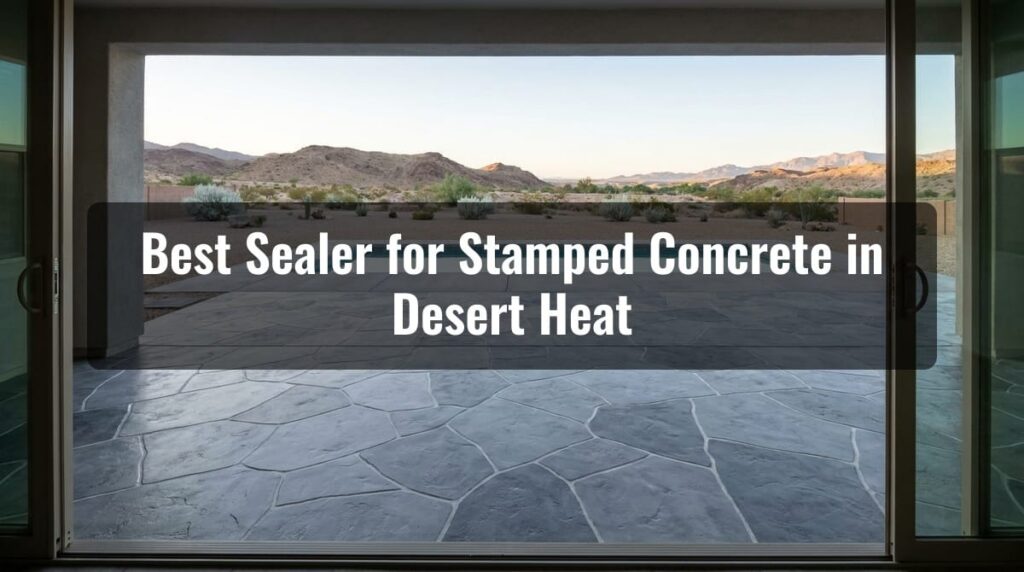
The best sealer for stamped concrete in the desert is usually a solvent-based acrylic like Brickform Gem-Seal or Poly-Seal. It gives the deep wet look most stamped patios are poured for. Buy it in the VOC version your air district allows. VOC stands for volatile organic compounds, the solvent that evaporates into the air as a sealer dries.
For a low-gloss finish that breathes, Gem-Guard SB is the pick, and a saltwater pool deck is the classic case. For soap-and-water cleanup, a satin finish, or curing and sealing new work in one step, go with Gem Cure & Seal WB.
Every one of these data sheets tops out at 85°F, and a Coachella Valley summer runs well past that, so the heat decides your work hours as much as the product does.
The best sealer for stamped concrete: four options side by side
All four rows come from Brickform’s technical information sheets (TIS). Solids tell you how much film is left once the solvent or water leaves. Coverage is per coat.
| Sealer | Type | Solids | Coverage per gallon | Finish | Apply between | Takes Traction Grip? | VOC versions |
|---|---|---|---|---|---|---|---|
| Gem-Seal | Solvent-based acrylic | 19% (100 VOC), 20% (350), 27% (700) | 250 to 350 sq ft | Medium to high gloss, wet look | 50°F to 85°F air | Yes | 100, 350, 700 |
| Poly-Seal | Solvent-based acrylic | 20% | 250 to 350 sq ft (250 to 300 in heat) | Medium to high gloss, wet look | 50°F to 85°F air | Yes | 100, 350, 650 |
| Gem-Guard SB | Penetrating silane/siloxane, solvent-based | 15% | About 250 sq ft | Low gloss wet look | 50°F to 85°F air | No | 100, 350, 600 |
| Gem Cure & Seal WB | Water-based acrylic cure and seal | 25% | About 300 sq ft | Clear satin | 45°F to 85°F air and concrete | Yes | 100 |
Sources: Gem-Seal 350 TIS, Gem-Seal 100 VOC TIS, Gem-Seal 700 TIS, Poly-Seal 350 TIS, Gem-Guard SB TIS, Gem Cure & Seal WB TIS and the Traction Grip data sheet.
Gem-Seal
The go-to wet look for stamped, stained and colored work. Brickform calls it non-yellowing and UV resistant, which counts under desert sun. The slab should be at least 28 days old and should soak up water, not bead it. Beading means more prep first.
Poly-Seal
Same family as Gem-Seal, with the same gloss and temperature window. In hot weather its sheet targets 250 to 300 sq ft per gallon.
Gem-Guard SB
Gem-Guard SB is a silane/siloxane sealer. In plain terms, it soaks into the concrete instead of forming a film on top. It lets vapor pass and gives color with a low gloss, without the plastic look. Brickform lists it as “great on saltwater pool decks.” It does not take Traction Grip.
Its sheet also disagrees with itself on slab age. The prep section says new slabs must be at least 28 days old, and the application section says 3 days. Plan on 28 days unless Brickform or the branch confirms the shorter wait for your job.
Gem Cure & Seal WB
The water-based pick: low odor, soap-and-water cleanup, clear satin. It also cures fresh concrete, applied right after final finish once surface water has gone. Its heat rule is stricter: both the air and the concrete must be between 45°F and 85°F.
Key Takeaway: Pick by finish first (high gloss, low gloss or satin), then by whether you need anti-slip grit, then by the VOC version your area allows.
The 85°F ceiling and a 109°F valley: how to seal stamped concrete in desert heat
Every sealer in the table above has an 85°F upper limit. Under NOAA’s 1991-2020 normals, Palm Springs’ normal daily high peaks at 109°F, with the hottest stretch running from mid-July into mid-August. Early September afternoons in the Coachella Valley still run hot, so the work has to fit the cool hours.
Seal anyway at 2 p.m. and you get exactly what the Gem-Seal TIS warns about. Above 85°F the solvent leaves too fast and the film never forms right. You get bubbling, blushing (a whitish haze), flaking, and adhesion failure later on. Direct sun and wind do the same.
A note for homeowners: Brickform’s data sheets say these sealers are intended for licensed contractors and installers. The Gem-Seal 100 VOC California safety data sheet says “Restricted to professional users.” If you plan to do it yourself, ask us at the branch which product suits a homeowner job, or hire a contractor.
How a late-summer sealing day should run
- Start at first light. Brickform says apply in the early morning while the slab is cool, not in direct sun, high heat or wind.
- Check the slab, not only the air. A sun-baked slab holds heat into the night, and Gem Cure & Seal WB caps the concrete at 85°F too. An infrared thermometer earns its keep.
- Go thin. In hot weather, Brickform targets about 300 sq ft per gallon. Spray two or three light coats and back-roll each one, meaning you roll it right after spraying to even out the coat. The sheet rates that above one heavy coat.
- Wait for tack free between coats.
- Watch the monsoon. The sheets say do not apply on rainy or foggy days. Check the forecast for the whole day, not just the morning.
- Keep traffic off. Plan on 24 hours before foot traffic and 72 hours before heavy traffic, per the Poly-Seal and Gem-Seal sheets.
Store the pails in the shade
The same Gem-Seal 100 VOC safety data sheet lists a flash point of 66°F and calls the product highly flammable, with direct sunlight and temperature extremes listed as conditions to avoid. On a warm desert morning the air can already be above 66°F. Keep the pail shaded and closed, and keep sparks and smoking away from the work.
If the job can wait, October and November bring more hours inside the 50°F to 85°F window.
Key Takeaway: In the desert, a summer sealing job is a dawn job on a cool, shaded slab, in thin coats at about 300 sq ft per gallon.
Solvent or water-based: what changes
Solvent-based acrylics give more gloss. The water-based option gives easy cleanup, low odor and can cure new concrete.
- Look. Gem-Seal and Poly-Seal give a medium to high gloss. Gem Cure & Seal WB dries satin. Gem-Guard SB is solvent-based but low gloss.
- Solids. The WB product runs 25%, Gem-Seal 350 runs 20% and Gem-Seal 700 runs 27%. Compare by the number, not by “solvent” versus “water”.
- Cleanup. Gem-Seal 100 and 350 clean up with acetone, Gem-Seal 700 with xylene, toluene or lacquer thinner, and the WB product with soap and water.
- New concrete. Only Gem Cure & Seal WB is built to cure fresh concrete. Gem-Seal wants a slab at least 28 days old.
Switching types on an old slab takes care. The Gem-Seal 350 TIS calls for removing old sealers and cure-and-seal products during prep, says the product is not recommended for pre-sealed or dense surfaces, and recommends a jobsite sample first. So ask whoever sealed it last or check the job records, then test a small patch.
No data sheet here gives a fixed reseal interval for either type. Brickform says to inspect the surface over time and reapply as needed.
Key Takeaway: Solvent acrylics give the most gloss, and the water-based option is the one for easy cleanup and new work. Before you switch types, know what is on the slab and test a patch.
Which VOC version fits each branch’s area
The number after a sealer’s name (100, 350, 600, 650, 700) is its VOC content in grams per liter (g/L). The limit depends on where the slab is, not where you bought the pail. In California it comes from the local air quality management district (AQMD), and the category printed on the label decides which line of the rule applies.
| Area | Who sets the rule | Limits to know | Where these sealers sit |
|---|---|---|---|
| Hesperia and the High Desert | Mojave Desert AQMD, Rule 1113 (as amended in 2012) | 100 g/L concrete/masonry sealers; 350 g/L curing compounds; 350 g/L reactive penetrating sealers | The 100 VOC versions sit at the 100 g/L sealer limit. The 350, 600, 650 and 700 versions are above it. |
| Thousand Palms and the Coachella Valley | South Coast AQMD | The district’s architectural coatings rule | Check the label category and VOC against the district’s rule. CARB’s model figure of 100 g/L is a pointer only. |
| Fort Mohave, the Mohave Valley and Nevada jobs | Federal limits (40 CFR 59) unless a local rule applies | 350 g/L curing compounds; 700 g/L curing and sealing compounds; 400 g/L concrete protective coatings; 600 g/L waterproofing sealers | Depends on the category printed on the label. |
Hesperia: Mojave Desert AQMD
The Mojave Desert AQMD covers the desert part of San Bernardino County, which takes in Hesperia and the Victor Valley. Its Rule 1113, as amended in 2012, sets 100 g/L for concrete/masonry sealers from January 1, 2013, and 350 g/L for concrete curing compounds. It applies to anyone who sells or applies these coatings in the district.
The same table has a 350 g/L line for reactive penetrating sealers, which soak in and bond chemically without leaving a surface film. Don’t assume a product fits that line; only its label can put it there. The 100 VOC versions of Gem-Seal, Poly-Seal and Gem-Guard SB, plus Gem Cure & Seal WB, are the ones at the 100 g/L sealer figure. Check with the district for later changes before a big job.
Thousand Palms: South Coast AQMD
The Coachella Valley falls under South Coast AQMD jurisdiction, so its architectural coatings rule applies on jobs from Palm Springs to Indio. Check the VOC and category on the label and SDS against that rule before you spray. For reference, CARB’s model rule for California air districts sets concrete/masonry sealers at 100 g/L, but that is the model, not South Coast’s own table.
Fort Mohave and Nevada: federal limits
Maricopa County’s low-VOC coatings rule, Rule 335, applies only inside Maricopa County. Mohave County is outside it. Concrete Decor notes that the rest of Arizona follows federal limits, and that federal limits cover any area without its own district or multistate rule.
Which line of the federal table applies (the four in the table above) depends on the category printed on the label, so check the label and SDS against it, the same as in California. If Mohave County or your city adopts its own coatings rule, that rule comes first.
What is in a 100 VOC solvent sealer
Gem-Seal 100 VOC gets to its number with VOC-exempt solvents. Its California SDS lists acetone and parachlorobenzotrifluoride, both exempt under CARB’s rule. The Gem-Seal 350 TIS adds that when Gem-Seal 100 goes over an existing Gem-Seal 350 coat, you spray it in several thin passes until fully covered. Under CARB’s model rule, a product labeled for more than one category takes the lowest limit.
Key Takeaway: Read the VOC number and category on the label, match it to the district where the slab sits, and ask the branch which versions they carry.
Pool decks: grip, gloss and a worked example
Around a pool, the best sealer for stamped concrete is one that stays grippy under wet bare feet. Every Brickform sheet says to apply thin coats, only on surfaces textured for slip resistance. Heavy coats or dense surfaces can get slippery where water sits, so keep sealer out of the low spots in the pattern. You have two routes.
- Gloss with grit. Use Gem-Seal, Poly-Seal or Gem Cure & Seal WB and mix in an anti-slip additive. Brickform’s Traction Grip is a fine powder that does not change color or gloss. The dose is one 16 oz container per 5-gallon pail.
- Low gloss, no film. Use Gem-Guard SB, which Brickform recommends for saltwater pool decks. It does not take Traction Grip, so the grip comes from the stamp texture itself.
Worked example: a 600 sq ft pool deck (example numbers)
Say you have a 600 sq ft stamped pool deck in Palm Desert and want the wet look with grip, using the hot-weather target.
| Step | Number |
|---|---|
| Deck area | 600 sq ft |
| Coats | 2 light coats |
| Coverage per coat in heat | About 300 sq ft per gallon |
| Sealer needed | 600 ÷ 300 × 2 = 4 gallons |
| Traction Grip | 16 oz per 5-gallon pail, so one container for the pail |
A 5-gallon pail covers it with a gallon to spare for the steps out of the pool. The Traction Grip sheet carries a silica warning, so wear a respirator while mixing. A porous deck may drink closer to 250 sq ft per gallon, so measure after the first coat. We don’t list an anti-skid additive on our site, so ask your branch whether we can get one for your job.
Key Takeaway: On a pool deck, choose thin coats with grit mixed in, or Gem-Guard SB with no grit and a low gloss.
Getting the right sealer and sprayer from Endura Steel
Endura Steel carries these Brickform sealers and the sprayers for them. The Gem-Seal page pairs the DS-8040 acetone sprayer with the 100 and 350 VOC versions and the DS-8041 solvent sprayer with the 700 VOC version. To narrow down the best sealer for stamped concrete on your job, bring your square footage, the finish you want and the slab’s city, and the counter can match the product and VOC version.
Get the Right Sealer From Endura Steel
- Call Thousand Palms at (760) 343-3100 for Coachella Valley pool decks and patios, Hesperia at (760) 244-5456 for the High Desert, or Ft. Mohave at (928) 754-7000 for the Mohave Valley and Nevada.
- Get a Quote online through our contact form.
- Contact your account manager about sealer, sprayers and the VOC version for your area.
Your success is our success.
Frequently asked questions
What temperature should you seal stamped concrete?
Brickform’s solvent sealers (Gem-Seal, Poly-Seal and Gem-Guard SB) call for an air temperature between 50°F and 85°F. Gem Cure & Seal WB needs both the air and the concrete between 45°F and 85°F. In desert summers that usually means sealing at first light on a slab that has cooled overnight.
How many square feet does a gallon of stamped concrete sealer cover?
Brickform lists about 250 to 350 sq ft per gallon per coat for Gem-Seal and Poly-Seal, depending on how porous the surface is. In hot weather the target is about 300 sq ft per gallon in two or three light coats. Gem-Guard SB is closer to 250 sq ft per gallon.
How long after sealing stamped concrete can you walk on it?
Brickform’s sheets say to keep foot traffic off for 24 hours and to wait 72 hours before heavy traffic such as cars. Let each coat get tack free before the next one goes on. Heat and humidity can change drying, so check the surface before opening it up.
Can you put solvent-based sealer over water-based sealer?
Check first. Brickform’s data sheets call for removing old sealers and cure-and-seal products during prep and recommend a jobsite sample before the full job. Find out what is already on the slab from whoever sealed it last, then test a small patch before you seal the whole thing.
Is a penetrating sealer better than an acrylic for a pool deck?
It depends on the look and grip you want. Gem-Guard SB is a silane/siloxane sealer that soaks in instead of forming a film, with a low gloss that lets vapor pass, and Brickform recommends it for saltwater pool decks. It does not take Traction Grip. An acrylic like Gem-Seal gives a glossier wet look and can carry an anti-slip additive.
