
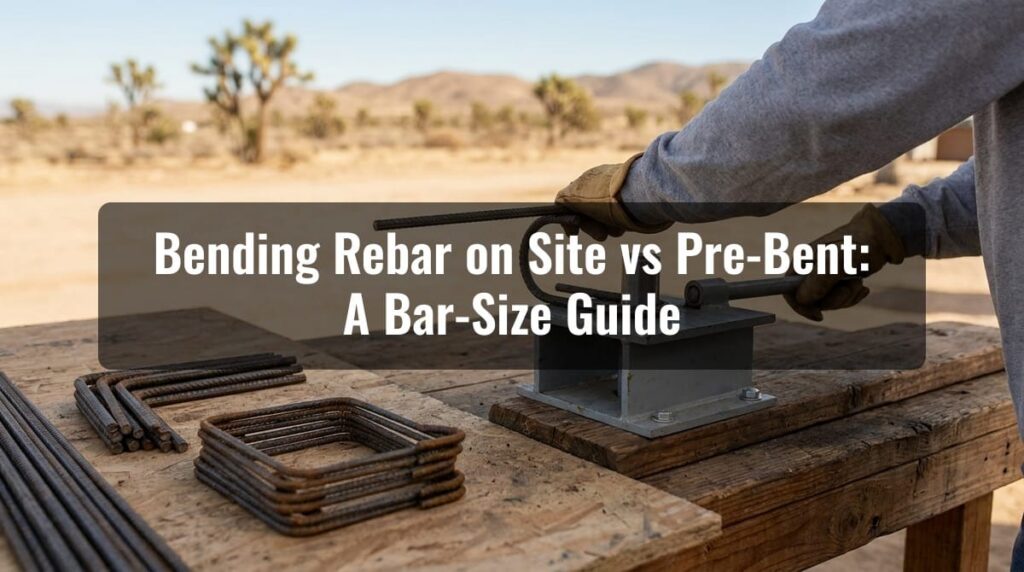
The drawing shows 90-degree hooks on the footing bars, a row of corner bars and a stack of ties. You have a hickey bar, a pile of straight bar and a pour coming up. Which of these bars can you bend yourself and still pass inspection, and which should come pre-bent from the shop? On most jobs, bending rebar on site vs pre-bent comes down to bar size.
Short answer: a few small bars (#3 to #5) you can usually bend on site, cold, if your tool bends around the diameter the code asks for. Larger bars, repeated shapes and seismic ties are better ordered shop-bent. A bar already cast in concrete is the engineer’s call.
Bending rebar on site vs pre-bent: the decision table by bar size
You can bend any loose bar cold before it is placed, but in practice only #3 to #5 bars are easy to bend right with site tools. The table sets ACI 318-19 minimum bend diameters (Tables 25.3.1 and 25.3.2) next to tool ratings and field-bending rules, from this ICC reinforced concrete inspector study guide. “db” means the bar’s nominal diameter.
| Bar size | Min. inside bend diameter, standard hook (Table 25.3.1) | Min. inside bend diameter, ties and stirrups (Table 25.3.2) | Site tools rated for this size | Loose bar, before placement | Bar already cast in concrete | Usual call (our guidance, not code) |
|---|---|---|---|---|---|---|
| #3 to #5 | 6db | 4db | Hickey bar rated to #5; angled hickey to #6 Grade 60; portable electric benders to #5 Grade 60 (in-place model, bender/cutter) | Bend cold (ACI 318-19 26.6.3.2) unless the engineer permits otherwise | Only if shown or permitted. ACI 301-20 default: cold bend once, bar above 32 F | Bend on site for a few bars, if the pin or mandrel meets the minimum |
| #6 to #8 | 6db | 6db | Angled hickey to #6 Grade 60; table-style electric bender to #8 Grade 60 (210 lb, 115 V) | Bend cold; no heat needed | Only if shown or permitted. ACI 301-20 default: preheat to 1100-1200 F | Order shop-bent: bigger pins, heavier tools |
| #9 to #11 | 8db | Not in the tie table | Portable hydraulic rod bender up to #11 (Navy training manual) | Bend cold | Same preheat default; NRC-hosted training slides limit it to #11 and smaller | Order shop-bent |
| #14 and #18 | 10db | Not in the tie table | None in our sources | Bend cold | Above the #11 limit in that training material | Shop only |
A tool’s size rating says it can bend the bar, not that the bend meets code. That depends on the pin or mandrel. The approved drawings, the specs and your local code edition govern your job.
Key Takeaway: #3 to #5 bars are where site bending is a normal, low-risk choice. From #6 up, a loose bar can still be bent cold if your tool and pin can do it. Bigger pins, heavier tools and repeat shapes usually favor the shop.
What the code asks of a bend, in plain inches
db is the nominal bar diameter: a #4 bar is 0.500 in and a #5 is 0.625 in, per Navy Steelworker Table 7-1. The inside bend diameter is measured across the inside of the curve. If a tool lists a bending radius, double it. The tail (the code calls it the extension) is the straight leg past the end of the bend.
The ACI 318-19 hook rules, per the inspector study guide:
- A 90-degree standard hook needs a straight tail of 12db.
- A 180-degree standard hook needs a tail of at least 4db and at least 2.5 in.
- Ties and stirrups in #3 to #5 with a 90- or 135-degree hook need a tail of at least 6db and at least 3 in. A #6 to #8 tie with a 90-degree hook needs 12db.
- Seismic hooks bend at least 135 degrees (90 for circular hoops). The tail is at least 6db and at least 3 in, and it points into the tie to wrap the long bar.
- A crosstie has a seismic hook on one end and a 90-degree or larger hook on the other (ACI 318-19 software note).
In inches you can check with a tape (our arithmetic from the sourced values):
| Bar | db (in) | Hook bend diameter, 6db (in) | 90-degree hook tail, 12db (in) | 180-degree hook tail (in) | Tie bend diameter, ACI (in) | Tie hook tail, 90 or 135 degrees (in) |
|---|---|---|---|---|---|---|
| #3 | 0.375 | 2-1/4 | 4-1/2 | 2-1/2 | 1-1/2 (4db) | 3 |
| #4 | 0.500 | 3 | 6 | 2-1/2 | 2 (4db) | 3 |
| #5 | 0.625 | 3-3/4 | 7-1/2 | 2-1/2 | 2-1/2 (4db) | 3-3/4 |
| #6 | 0.750 | 4-1/2 | 9 | 3 | 4-1/2 (6db) | 4-1/2 at 135; 9 at 90 |
One wrinkle for ties. The CRSI Manual of Standard Practice, 2018 (29th) edition, raised its tie and stirrup minimums. For #3, #4 and #5 they are 2 in, 2-1/2 in and 3-1/4 in, about 5db. ACI 318-19 still says 4db. As ASPIRE magazine explained in 2022, a spec that references ACI 318 is not affected, but one that references that CRSI edition is. Check which edition your spec names.
Key Takeaway: Know three numbers for every bar you bend: the minimum inside diameter, the hook angle and the tail length. If your spec cites the 2018 CRSI manual, use its larger tie diameters.
Worked example: one #4 corner bar and one #4 tie
This is an example of the method, not a design.
The #4 corner bar with a 90-degree hook
A #4 bar is 0.500 in across and weighs 0.668 lb per foot. A 90-degree standard hook needs an inside bend diameter of at least 6db, so 3 in, and a straight tail of 12db, so 6 in. That 6 in tail is half a foot of bar, which adds about 0.33 lb of steel per hook.
The #4 tie with seismic hooks
The same bar as a tie needs an inside bend diameter of at least 2 in under ACI 318-19 (2-1/2 in if your spec references the 2018 CRSI manual; check the edition your spec names). If the drawings call for seismic hooks, each end bends at least 135 degrees. Each tail is at least 3 in (6db is also 3 in on a #4), turned into the tie so it wraps the corner bar.
Check the tool against the numbers
Take one portable in-place bender rated to #5. Its listed 1.25 in bending radius makes a 2.5 in bend diameter:
- On a #4 tie, 2.5 in meets the ACI 2 in minimum and the 2018 CRSI 2-1/2 in figure.
- On a #4 standard hook, 2.5 in is under the 3 in the code asks for.
- On a #5 tie, 2.5 in is exactly 4db. It meets ACI 318-19 but falls under the CRSI 3-1/4 in figure.
- On a #5 standard hook, it is under the 3-3/4 in minimum.
- That model bends up to 90 degrees, so a 135-degree seismic hook needs a different tool.
The tool is fine for ties. For hooks, match the mandrel to the bend before you buy or rent. With a hickey bar, per the Navy Steelworker manual, you set its jaws on one side of the bend center and pull, so the curve depends on the hand. For hooks an inspector will measure, a pin or table bender is more repeatable.
Key Takeaway: Before you bend, write the minimum diameter and tail on the bar list next to each shape, then check your tool’s pin size against it.
How to bend rebar on site so it passes
Here is how to bend rebar so the inspector sees what the drawing shows. These steps are our practice, built on the sources above:
- Set the pin first. Use a pin or mandrel at least as wide as the minimum inside diameter. On a hickey bend, check the curve with a round template of that size.
- Mark from the bar list. Bar lists give out-to-out lengths for each leg, measured at the typical points set out in the CRSI Manual of Standard Practice, Chapter 7.
- Bend one test bar. Check legs, angle, tail and hook direction against the list and drawing. Adjust your marks before you bend the rest.
- Bend once, cold. Don’t straighten a bar and bend it again. The NRC-hosted slides say a previously bent bar must be heated first, which makes it the engineer’s call.
Key Takeaway: Right pin, marks from the list, one test bar checked, then one cold bend per spot.
Field-bending rules: bend cold, leave cast bars alone, keep the torch away
Bend rebar cold, before it is placed, and leave bars sticking out of concrete alone unless the drawings or the engineer allow it. That is ACI 318-19 Section 26.6.3, per the study guide summary. The licensed design professional can permit otherwise.
For bars partly embedded in concrete, when bending them is permitted and the documents give no method, ACI 301-20 Section 3.3.2.8 supplies a default. It is for the engineer and the spec to apply, not a DIY recipe:
- #3 to #5 bars may be cold bent one time if the bar is above 32 F.
- Other sizes are preheated over at least five bar diameters on each side of the bend center. They are held at 1100 to 1200 F through the bend.
- No more than 500 F at the concrete face, no heating below the concrete surface, and no artificial cooling until the bar drops below 600 F.
- ASTM A1035 bars are not heated under this procedure.
Engineering training slides hosted by the US NRC say bending bars in place is used to fix wrong fabrication, wrong placement or a design change. It needs the drawings or the engineer’s say-so and is limited to #11 and smaller. A #3 to #5 bar that has never been bent can be bent cold in place. #6 to #11 bars are heated first.
The Navy manual warns that overheating reduces strength and can make the steel brittle. Engineers at Simpson Gumpertz & Heger reported several Grade 80 #11 bars that cracked at their bends during routine placement in cold weather. Material, chemistry, bending procedure and temperature all played a part.
Cold mornings matter for dowels sticking out of a cast footing or wall. As fall turns to winter around Hesperia, a #4 dowel at or below freezing is outside the ACI 301 cold-bend default, even when the bend is allowed. Wait for the steel to warm up or ask the engineer.
Key Takeaway: Loose bar of any size is bent cold. Bars sticking out of cured concrete, rebends and anything that needs a torch are the engineer’s call, not the crew’s.
When shop-bent rebar pays off, and when it doesn’t
Pre-bent rebar earns its keep in a few clear cases:
- Repeated shapes. Ties and corner bars by the dozen.
- #6 and larger. Bend diameters grow and tools get heavy (that #8 table bender weighs 210 lb). Heat only comes in for bars already cast in concrete, and then it needs the engineer.
- Seismic ties. 135-degree hooks with set tails are hard to repeat with a hand tool.
- Shapes from a bar bending schedule. CRSI Manual of Standard Practice Chapter 7 covers standard bend shapes, measuring points, fabricating tolerances and inspection of fabricated bars. A shape number on your schedule means the same bend at the shop.
Where does site time go? The bend itself is quick on a machine. Makers list under 4 seconds for a 90-degree bend on the in-place bender and 9 seconds for a 180-degree bend on the table bender. So on site, the hours go into marking each bar, bending test bars, changing pins and redoing a short tail. That is our reasoning, not a measured figure. Pre-bent shapes arrive matching the schedule, so the crew places and ties instead of bending piece by piece.
Shop bending won’t erase waste. A 2021 review of 52 studies found that about 3 to 5% of rebar still ends up as cutting waste even with optimization. The authors note that most studies optimize around standard stock lengths, which makes near-zero waste hard.
It is not always cheaper, either. A 2005 study of one trade center project in Istanbul found off-site fabrication would have raised total rebar cost by 1.2%. The authors tied that to low wages, high shipping costs, an unreliable supply chain, inflation and material waste. In a companion paper, the same researchers found contractors chose site bending mostly because of poor coordination and a flawed ordering process. They argued the cost comparison could come out differently if those problems were fixed.
Site bending still makes sense for a handful of #3 or #4 bars or a garden wall. At Endura Steel, we can cut, bend, and shape rebar to your project’s exact engineering specifications and deliver it to your job site. For shop versus field on other metal work, see When Custom Fabrication Saves Money.
Key Takeaway: Order pre-bent when the shapes repeat, the bars are #6 or larger, or the ties are seismic. Bend on site when it is a few small bars and your tool meets the minimum diameter.
What to send when you order bent bar
With each shape, send the bar size, grade (ask about availability) and quantity. Add a bar list with every leg, hook angle and tail, plus any spec note on tie bend diameters or coating. For the full list, use our Rebar Ordering Checklist.
Get Bent Rebar From Endura Steel
Send your bar bending schedule or the drawing with the hooks marked, and Endura Steel will cut and bend the rebar to spec and deliver it.
- Call a branch: Hesperia (760) 244-5456, Thousand Palms (760) 343-3100, Ft. Mohave (928) 754-7000.
- Get a Quote online through our contact form.
- Talk to your account manager about the shapes on your next pour.
Your success is our success.
Frequently asked questions
Can you bend rebar that is already in concrete?
Only when the construction documents show that bend or the design professional permits it, under ACI 318-19 Section 26.6.3. For a partly embedded bar with no method in the documents, ACI 301-20 lets #3 to #5 bars be cold bent one time above 32 F. Larger sizes need a controlled preheat that keeps the concrete face at 500 F or less. Ask the engineer before you touch a cast bar.
Does heating rebar to bend it weaken it?
It can. The Navy Steelworker manual warns that overheating reduces strength and can make the steel brittle. Loose bar is bent cold under ACI 318-19, and heat comes in only for bars already cast in concrete, under a procedure the engineer approves, such as the 1100 to 1200 F preheat in ACI 301-20.
What size rebar can you bend by hand?
One maker’s standard hickey bar is rated to #5, and its angled model to #6 Grade 60. Whether that bend meets code is a separate question, because a hickey bends around its jaws rather than a sized pin. For hooks an inspector will measure, check the bend diameter against the ACI minimum, such as 3 in for a #4 standard hook.
Can you straighten a bent bar and bend it again?
For bars bent in place, engineering training slides hosted by the US NRC say a #3 to #5 bar that was already bent must be heated before it is straightened and rebent, and #6 to #11 bars are heated before they are bent in place. That makes a rebend an engineer’s call. For a loose bar, it is usually simpler to replace it than to rebend it.
Is pre-bent rebar cheaper than bending it yourself?
Not always. One 2005 study found off-site bending would have raised total rebar cost by 1.2% on one project in Istanbul with low wages and high shipping costs. The shop tends to pay off when shapes repeat, bars are #6 or larger and the bending schedule is clean.
